Rolling covered calls is one of the most important decisions in an Ethereum wheel strategy.
The goal is not to chase every extra dollar of premium. The goal is to stay in the game, use capital wisely, manage risk, and avoid turning a profitable position into an unnecessarily complicated one.
One lesson I've learned from running the wheel strategy is that successful rolls are rarely about chasing more premium. They're about improving an already profitable position while staying disciplined and giving capital the best chance to keep compounding.
If you are new to covered calls, start with our guide: How to Generate Income With Ethereum Covered Calls.
The Situation: A Profitable Covered Call Under Pressure
Assume Ethereum is trading around $1,721. At the time of writing, I am managing a covered call position that originated from an Ethereum wheel strategy started on June 5, 2026.
The original Ethereum acquisition price was approximately $1,563. Since then, the position has generated multiple rounds of option premium through covered call sales while Ethereum gradually recovered.
Over the past several weeks, I have already rolled the covered call position multiple times. Each adjustment was made for a net credit while keeping the overall strategy aligned with the original objective: generating income while maintaining long-term exposure to Ethereum.
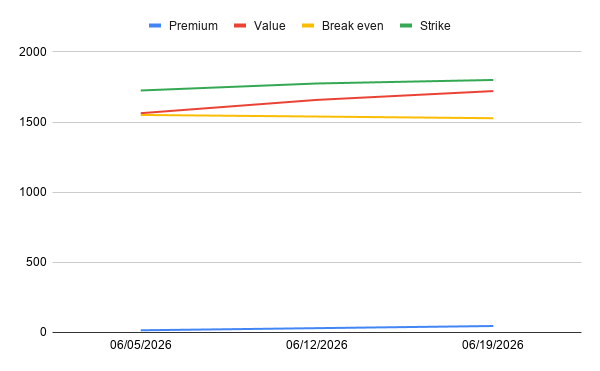
Today, I have an opportunity to roll a $1,775 covered call to next week's $1,800 strike while collecting additional premium.
This is exactly the type of decision many wheel traders face regularly. Personally, I am quite happy with the trade regardless of the eventual outcome.
If Ethereum remains below the strike price, I collect another round of premium and continue holding the underlying asset.
If Ethereum is eventually called away at $1,800, the position will realize a substantial capital gain in addition to all premiums collected since entering the trade.
That perspective is important because one of the most common mistakes in covered call trading is viewing assignment as failure.
In reality, this position has already been profitable for weeks. The decision now is not about avoiding losses. It is about choosing the most efficient way to manage a winning trade.
A covered call position is currently open with a $1,775 strike price. The call is still out-of-the-money, but ETH has moved closer to the strike, creating a decision point.
The trader has two choices:
- Wait until Friday and see whether the option expires worthless.
- Roll the covered call early to the next expiration.
In this example, the available roll looks like this:
- Buy back the current $1,775 call for $15.90.
- Sell next week's $1,800 call for $29.50.
- Net credit received: $13.60.
This is a favorable roll because it produces a credit while also raising the strike price.
Why This Roll Is Attractive
The roll improves the position in three ways:
- It collects an additional $13.60 in premium.
- It raises the strike from $1,775 to $1,800.
- It keeps the wheel strategy running for another week.
The effective improvement is approximately:
- $13.60 additional premium
- $25.00 additional upside from the higher strike
That creates a total improvement of roughly $38.60 per ETH compared with allowing assignment at $1,775.
Since ETH is trading around $1,721, the new $1,800 strike still leaves approximately 4.6% room before assignment.
Comparing the Two Outcomes
Option 1: Do Nothing
If no adjustment is made, the maximum sale price remains $1,775. If ETH trades above $1,775 by expiration, the ETH may be called away at that price.
Option 2: Roll the Call
If the position is rolled, the trader receives an additional $13.60 credit and raises the potential sale price to $1,800. If ETH remains below $1,800 next week, the trader keeps the premium and still owns the ETH. If ETH rises above $1,800, the ETH may be called away at a better price than before.
Why Rolling Can Make Sense in the Wheel Strategy
For someone running an Ethereum wheel strategy, rolling can make sense when the adjustment improves the position without adding meaningful new risk.
A good roll usually has at least one of the following benefits:
- It generates a net credit.
- It raises the strike price.
- It gives the position more time.
- It avoids unnecessary assignment.
- It keeps capital working efficiently.
In this case, the roll does several of those things at once.
When Waiting Might Be Better
Rolling early is not always the best choice. The main reason to wait would be if the trader expects ETH to remain below $1,775 for most of the week. In that case, the current call may decay faster, potentially creating a better roll opportunity later.
However, that is a market-timing decision.
The roll available now already offers:
- Positive credit
- A higher strike price
- No additional capital requirement
- Continued out-of-the-money positioning
For a disciplined wheel trader, that is often enough.
The Assignment Question
A common mistake is treating assignment as failure. In a wheel strategy, assignment can be a successful outcome if the position was entered with a clear plan.
Assume the ETH cost basis is $1,563. If ETH is eventually called away at $1,800, the capital gain is $237 per ETH, before counting accumulated option premiums.
That is exactly the kind of outcome many wheel traders hope for.
The purpose of rolling is not to avoid assignment forever. The purpose is to improve the trade when the terms are attractive.
Return Example: Assignment at $1,800
Using the example numbers:
- Cost basis: $1,563
- Assignment price: $1,800
- Position size: 1.3 ETH
- Capital deployed: $2,031.90
- Total estimated profit: $367.75
- Holding period: 21 days
The return on capital is approximately:
$367.75 / $2,031.90 = 18.10%
That means the trade would generate approximately 18.1% in 21 days.
Annualized Return
A simple annualized return estimate would be:
18.10% × 365 / 21 = approximately 314%
A compounded annualized calculation would be much higher, but that figure is not realistic because the same setup will not be available every 21 days throughout an entire year.
For options trading, simple annualized return is usually more useful as a comparison metric than a forecast.
Why Discipline Matters More Than Optimization
The biggest mistake many wheel traders make is endlessly rolling profitable covered calls because they do not want to lose the underlying asset.
That can turn a winning trade into a weaker one.
Eventually, the trader may start:
- Chasing the market
- Rolling too far into the future
- Accepting poor risk-reward
- Defending positions that no longer need defending
In this example, rolling from $1,775 to $1,800 for a credit is reasonable.
But if ETH is called away at $1,800 next week, that should be viewed as a successful completed wheel cycle, not a problem.
Learn more about strike selection: How to Choose Strike Prices for Ethereum Covered Calls.
When to Roll a Covered Call
A covered call roll is most attractive when several conditions are met:
- The roll can be done for a net credit.
- The new strike is higher than the old strike.
- The new expiration is not too far away.
- The trader still wants to hold the underlying asset.
- The position remains consistent with the original strategy.
Rolling becomes less attractive when the trader is only rolling because they are emotionally attached to the underlying asset.
Final Thoughts
Rolling covered calls is not about winning every possible outcome.
It is about improving position quality, keeping the strategy active, and using capital efficiently.
In this example, rolling the $1,775 call to the next week's $1,800 call for a credit is a reasonable adjustment. It increases premium income, raises the potential sale price, and keeps the Ethereum wheel strategy running.
However, if ETH is eventually called away at $1,800, that should still be considered a strong result.
The goal is not to avoid assignment forever.
The goal is to generate income, manage risk, stay disciplined, and keep capital working over time.
Continue Learning
- How to Generate Income With Ethereum Options
- How to Generate Income With Ethereum Covered Calls
- How to Choose Strike Prices for Ethereum Covered Calls
- How to Generate Income With Ethereum Cash-Secured Puts
Risk Disclosure
This article is provided for educational and informational purposes only and does not constitute investment advice, financial advice, or a recommendation to buy or sell any financial instrument.
Options trading and cryptocurrency investing involve substantial risk, including the potential loss of capital. Past performance does not guarantee future results.
Join the OptionsBrew newsletter
Get practical notes on options income, trade adjustments, and risk management.