Generating $125 per week from options trading may not sound extraordinary, but for many investors it represents a meaningful source of recurring income.
At Terramatris, we primarily use options as an income-generation and portfolio-management tool. Rather than attempting to predict every market move, we focus on collecting option premium while managing risk and maintaining long-term exposure to high-conviction assets such as Ethereum.
If you are new to the topic, start with our guide: How to Generate Income With Ethereum Options.
The Goal: Generate Consistent Premium Income
The basic concept is simple:
- Sell options.
- Collect premium upfront.
- Repeat the process over time.
The objective is not to win every trade. The objective is to systematically generate income while managing risk appropriately.
Many successful options strategies focus on:
- Efficient use of capital.
- Consistent premium collection.
- Risk management.
- Long-term portfolio growth.
A Real Ethereum Options Example
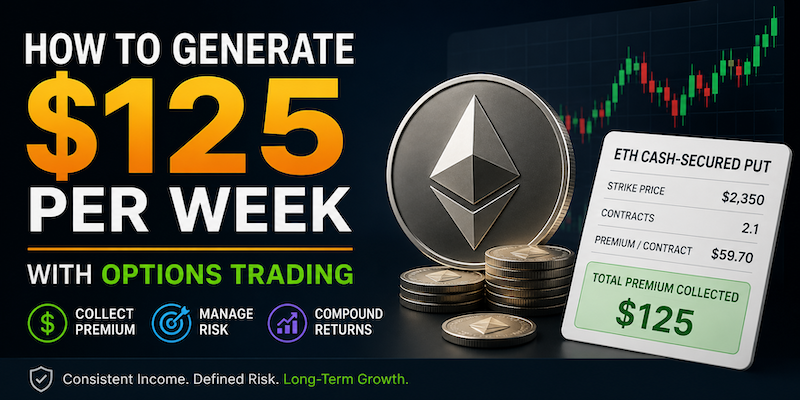
In May 2026, we evaluated the following Ethereum cash-secured put trade:
- Underlying: Ethereum (ETH)
- Strategy: Short put
- Strike price: $2,350
- Position size: 2.1 ETH
- Premium: Approximately $59.70 per contract
- Total premium collected: Approximately $125
At first glance, the trade appears attractive because it immediately achieves the income target.
However, understanding the risk is more important than understanding the premium.
What Selling a Put Actually Means
When selling a put option, you are agreeing to potentially buy Ethereum at the selected strike price.
In this case:
"We are willing to purchase ETH at $2,350 if assigned."
In exchange for making that commitment, we receive option premium upfront.
This is one reason many investors use cash-secured puts as an alternative to placing limit orders.
Learn more: How to Generate Income With Ethereum Cash-Secured Puts.
The Importance of Delta
One of the most important metrics in options trading is delta.
The trade above had a delta of approximately -0.41.
While delta is not a perfect probability measure, many traders use it as a rough estimate of assignment risk.
A delta near -0.41 suggests:
- Roughly 41% probability of finishing in-the-money.
- Roughly 59% probability of expiring worthless.
This is not a conservative premium-selling trade.
It is closer to a moderately bullish position with income generation attached.
Why Premium Is Not Free Money
A common misconception among new traders is that option premium represents guaranteed income.
The premium itself is guaranteed once collected.
The outcome is not.
If Ethereum remains above the strike price, the option may expire worthless and the entire premium is retained.
If Ethereum falls below the strike price, the trader may be assigned and become a buyer of ETH at the strike price.
If Ethereum experiences a large decline, losses can easily exceed the premium collected.
This is why risk management is often more important than premium generation.
Why Traders Still Sell Puts
Despite the risks, cash-secured puts remain one of the most popular income strategies in both traditional and crypto markets.
Several factors make them attractive:
1. Crypto Volatility Creates Premium
Ethereum options often contain significant implied volatility.
Higher volatility generally translates into higher option premiums.
2. Weekly Expirations Create Opportunities
Short-dated options allow traders to repeatedly collect premium and reassess market conditions.
This is one reason many wheel strategy traders prefer weekly expirations.
3. Assignment Can Be Acceptable
If you already want to own Ethereum, assignment is not necessarily a negative outcome.
Many investors intentionally use cash-secured puts as a way to acquire ETH while collecting premium along the way.
The Capital Requirement
Generating income from options always requires capital.
In our example:
2.1 ETH × $2,350 = approximately $4,935 of exposure.
Effectively, roughly $5,000 of capital was being used to target approximately $125 of weekly premium.
That represents a potential weekly return of around 2.5%.
High returns are possible, but they always come with meaningful risk.
The Terramatris Perspective
At Terramatris, we do not view trades like this as safe income opportunities.
We view them as controlled risk exposures where income is a byproduct of accepting specific market risks.
Before entering a short put position, we typically ask:
- Would we be comfortable owning Ethereum at this strike?
- Is the premium sufficient for the risk being taken?
- Can the position be managed if market conditions change?
- Is the position size appropriate?
If the answer is no, we pass on the trade.
Conservative vs Aggressive Put Selling
| Approach | Typical Delta | Risk | Premium Potential |
|---|---|---|---|
| Deep OTM Puts | -0.10 | Lower | Lower |
| Moderate OTM Puts | -0.25 | Medium | Medium |
| Aggressive Puts | -0.40+ | Higher | Higher |
There is no free lunch.
Higher income generally requires accepting greater assignment risk.
How This Fits Into the Wheel Strategy
Many investors combine cash-secured puts and covered calls through a wheel strategy.
The process typically works like this:
- Sell cash-secured puts.
- Accept assignment if it occurs.
- Sell covered calls against the acquired ETH.
- Repeat the cycle.
For long-term investors, this can create a systematic framework for generating option income while maintaining exposure to Ethereum.
- Learn more: How to Generate Income With Ethereum Covered Calls.
- Also see: When to Roll Ethereum Covered Calls.
Final Thoughts
Generating $125 per week from Ethereum options is entirely realistic. The more important question is not whether the premium can be collected. The more important question is what risks must be accepted to earn it. Successful options trading is rarely about maximizing weekly income.
Instead, it is about balancing:
- Premium generation.
- Position sizing.
- Risk management.
- Long-term capital preservation.
In the long run, consistency tends to outperform intensity.
Continue Learning
Join the OptionsBrew newsletter
Get practical notes on options income, trade adjustments, and risk management.