TerraMatris research note, September 2026. This article describes our own positions and execution experience. It is not investment advice and does not treat option premium as a substitute for risk management.
On September 4, 2025, TerraMatris launched its dedicated Solana strategy: long SOL exposure with selective covered calls and cash-secured puts. A year is long enough to move past the first impression of a new market. We can now ask a more useful question than whether SOL options exist: after one year of using them, has the market matured enough to support systematic covered-call and put-selling strategies as reliably as Bitcoin or Ethereum?
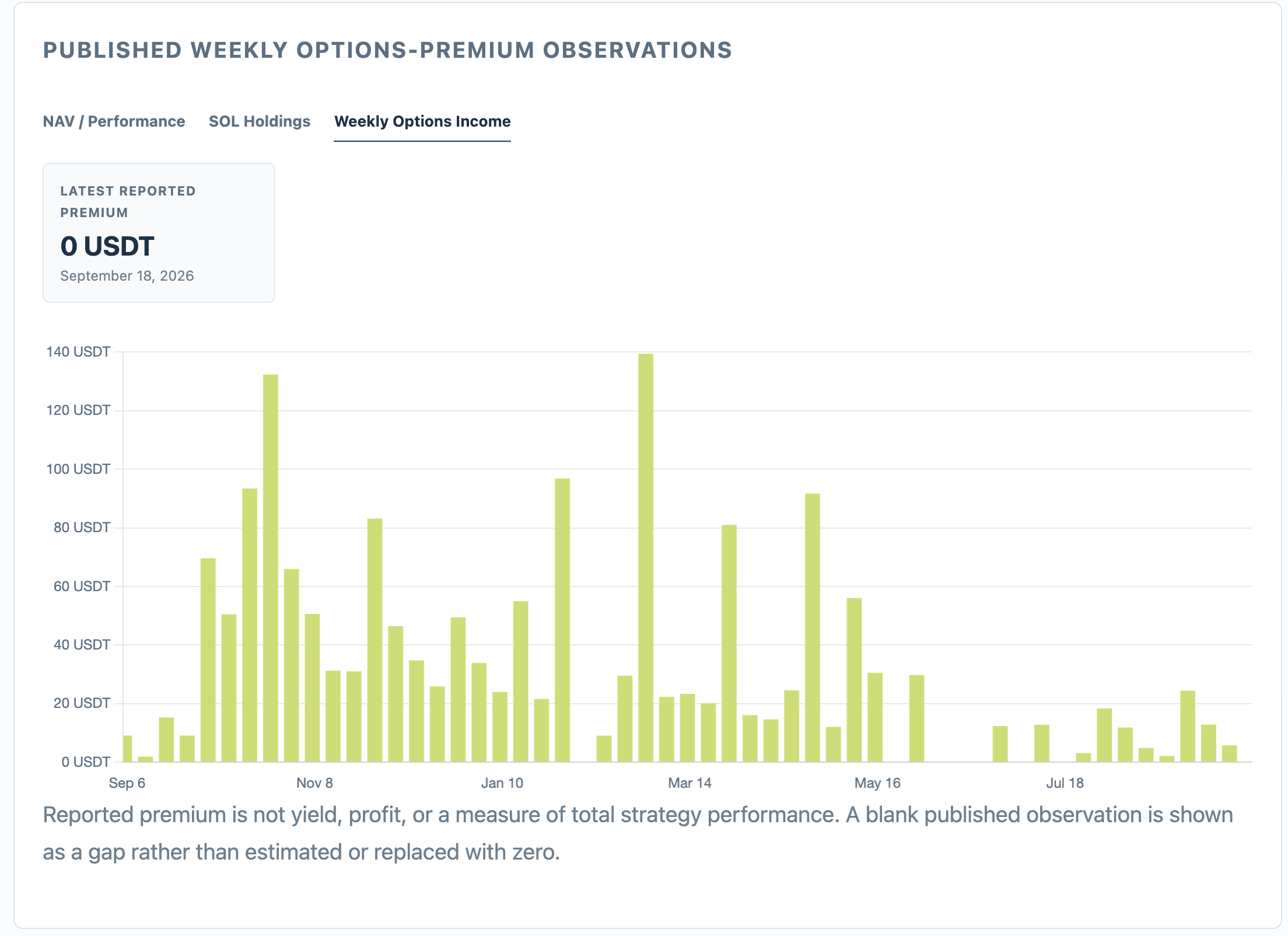
Our answer is cautious. SOL options are more accessible than when we began. There are several credible venues, weekly contracts exist, and a regulated CME product has arrived. Yet access is not the same as liquidity, and liquidity is not the same as rollability. What looks attractive on the option chain can become much less attractive when the position needs to be changed.
In our experience, the problem is not necessarily opening the trade. The problem appears when it needs to be managed: a call is challenged, we want a higher strike and a nearer expiry, and the contract that is technically listed is not a useful execution. That does not make SOL options unusable. It does mean the strategy has to start with a much more serious willingness to accept assignment than the same trade might require in BTC or ETH.
What changed since we launched in September 2025
The SOL options market is broader today than when we launched our strategy in September 2025. Deribit and Bybit both offer SOL options, CME added options on standard and Micro SOL futures in October 2025, and additional venues such as Derive and Binance now contribute to the market.
There are also more expiries available than we initially assumed. Weekly SOL options do exist, alongside monthly and longer-dated contracts. On paper, that gives traders more flexibility.
In practice, however, having an expiry listed does not necessarily mean there is a useful trade available.
That distinction has become increasingly important in our own strategy. When a covered call moves against us, we are not simply looking for another expiry. We need a strike further out, at a sensible premium, with enough liquidity to close the existing position and open the new one without giving up too much in the spread.
This is where SOL still feels very different from BTC or ETH.
The market has grown, but our experience over the past year suggests that usable liquidity can still disappear quickly once we move away from the most active strikes and expiries. A weekly contract may exist, but the roll we actually want may offer little or no credit, have a wide spread, or force us much further out in time than we would prefer.
That is the real issue for us: not whether SOL options exist, but whether they provide enough flexibility once a position needs to be managed.
Where SOL options trade today
Our current venue review found four active offshore venues in Loris Tools’ cross-exchange SOL dashboard: Deribit, Bybit, Derive and Binance.
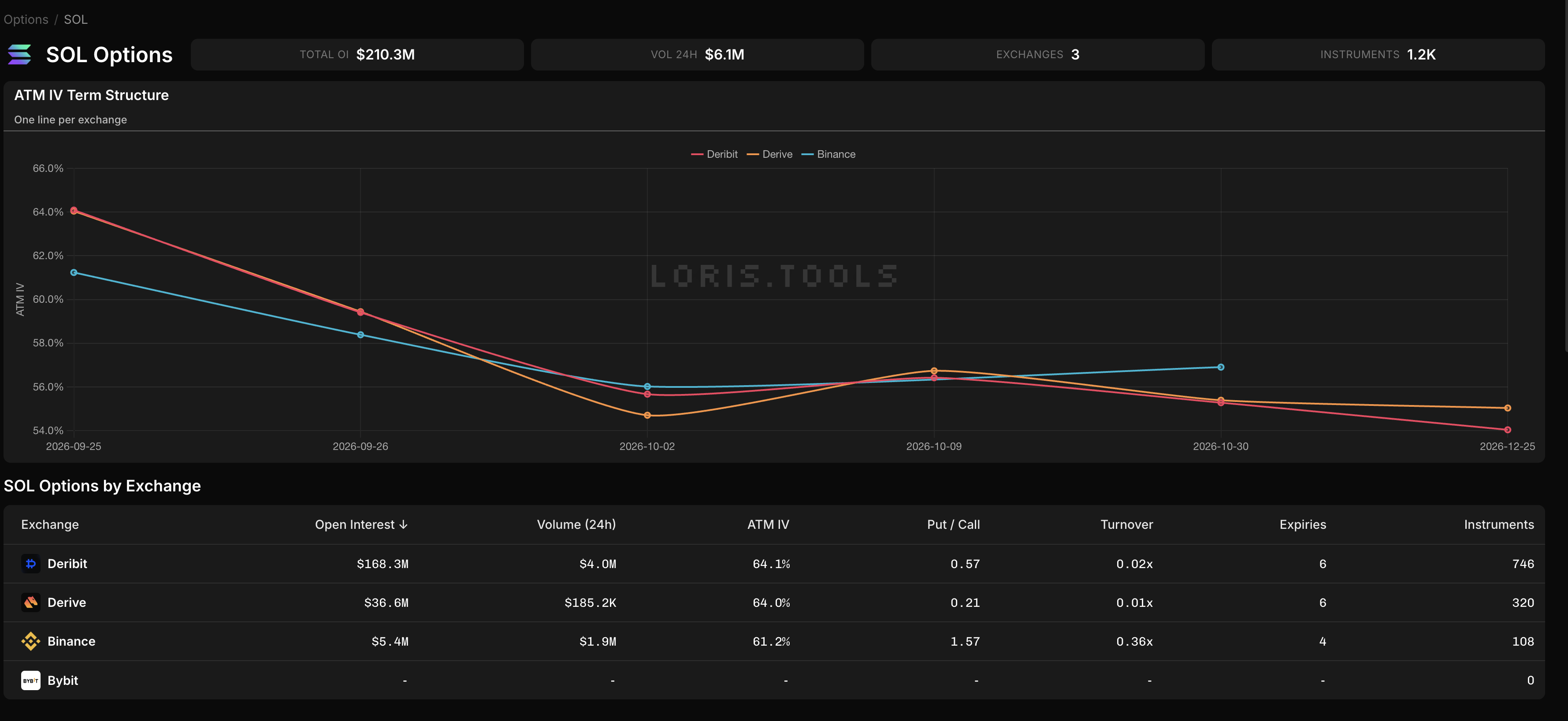
The dashboard reported $227.35 million of tracked SOL open interest, $14.04 million of 24-hour notional volume and 1,564 active instruments across those venues at the time checked.
Deribit dominated: $167.65 million of open interest, $3.94 million of 24-hour volume, six expiry groups and 744 listed instruments. Derive reported $36.47 million of open interest; Binance $5.33 million. Bybit’s venue page reported 158,127 aggregate SOL option contracts open and 71,181 contracts of 24-hour volume, but contract counts are not directly comparable with dollar notional across exchanges.
There is also a distinct regulated market. CME’s SOL and Micro SOL options are options on futures, not spot-covered calls. That matters for collateral, settlement and the position being hedged. CME’s own launch notice says that daily, monthly and quarterly expiries are available; its 2026 rules show Monday through Friday weekly series and progressively denser strikes nearer expiry. Those products expand institutional access, but their existence should not be treated as proof that a spot holder can roll an offshore covered call efficiently.
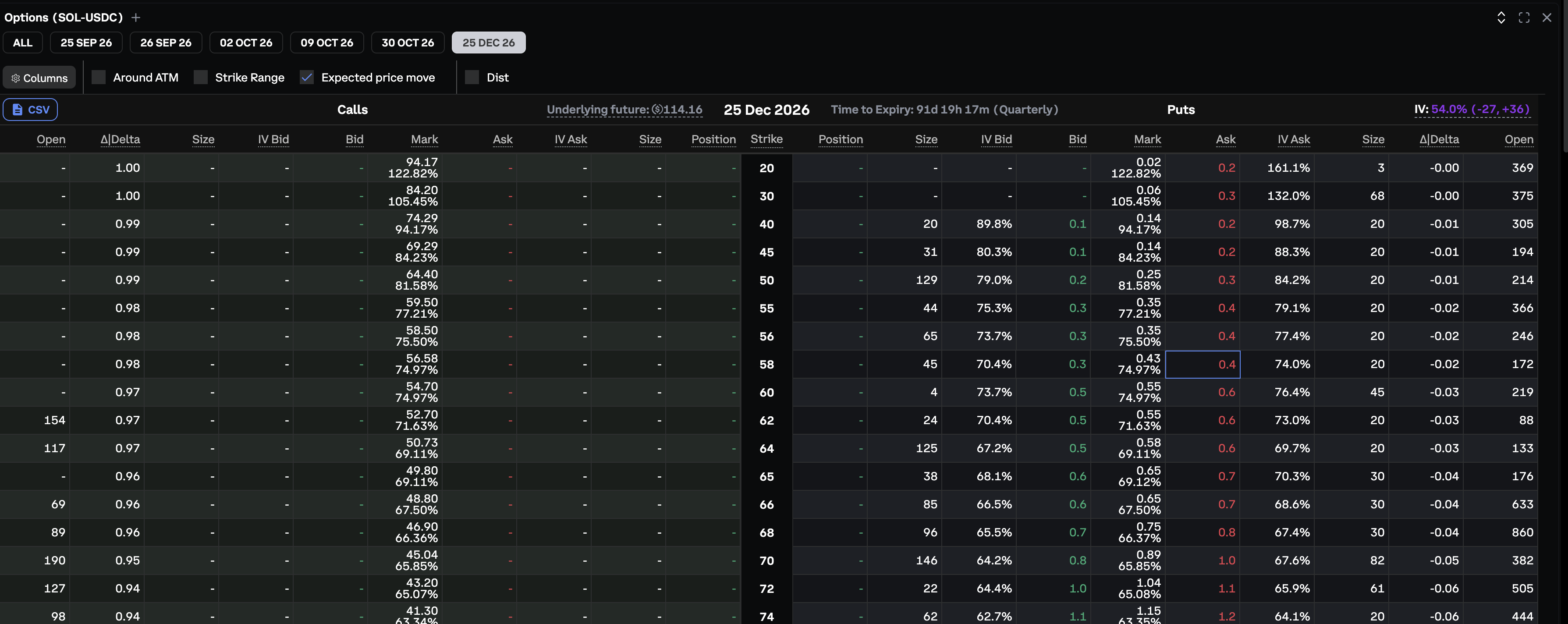
Deribit is the clearest public window into chain construction. Its live USDC summary showed six SOL expiry dates and 744 SOL instruments in our snapshot. Half displayed both a positive bid and ask. That is a useful warning rather than a universal spread statistic: a two-sided quote does not tell us how much size is available, whether it survives an order, or whether it sits near a fair midpoint. It does show why counting listed contracts can overstate usable choice.
Availability, liquidity and rollability are different things
“Liquidity” is too broad to guide a real trade. We separate it into five tests.
- Entry liquidity. Can we open the call or put we actually want at a reasonable bid/ask spread and meaningful size?
- Exit liquidity. Can we later close it without surrendering much of the premium collected at entry?
- Rolling liquidity. Can we close a challenged option and open a useful replacement—higher or lower strike, appropriate expiry—without turning the adjustment into a poor trade?
- Expiry liquidity. A Friday contract is not automatically useful merely because it is listed. Its relevant strikes still need tradable quotes.
- Strike liquidity. The market may quote near ATM while a covered-call seller needs a materially OTM strike. Liquidity often deteriorates precisely where the strategy needs it.
Open interest is only one of those tests. A contract can have open interest from an earlier transaction and still offer no compelling bid when we need to leave. A screen can show a bid and ask while the spread consumes most of a small premium. A quoted weekly can be irrelevant if moving a Friday call one week forward and $5–$10 higher produces negligible credit or a worse risk/reward profile.
This is the practical expiry problem behind many of our decisions. We may prefer to move a challenged call from one Friday to the next. If the useful strike has no real bid, the spread is too wide, or the credit is too small, the next acceptable choice can be an end-of-month contract 30–45 days out. That ties up the covered SOL for longer, reduces opportunities to re-select the strike, makes annualised premium less meaningful, and leaves upside capped through a larger part of a volatile move.
What a year of real SOL trades taught us
Our Solana strategy record now states the approach plainly: assess strike, expiry, premium, liquidity and execution; accept assignment as a possible outcome; and do not treat option sales as an automatic weekly cycle. That language was earned through the trades.
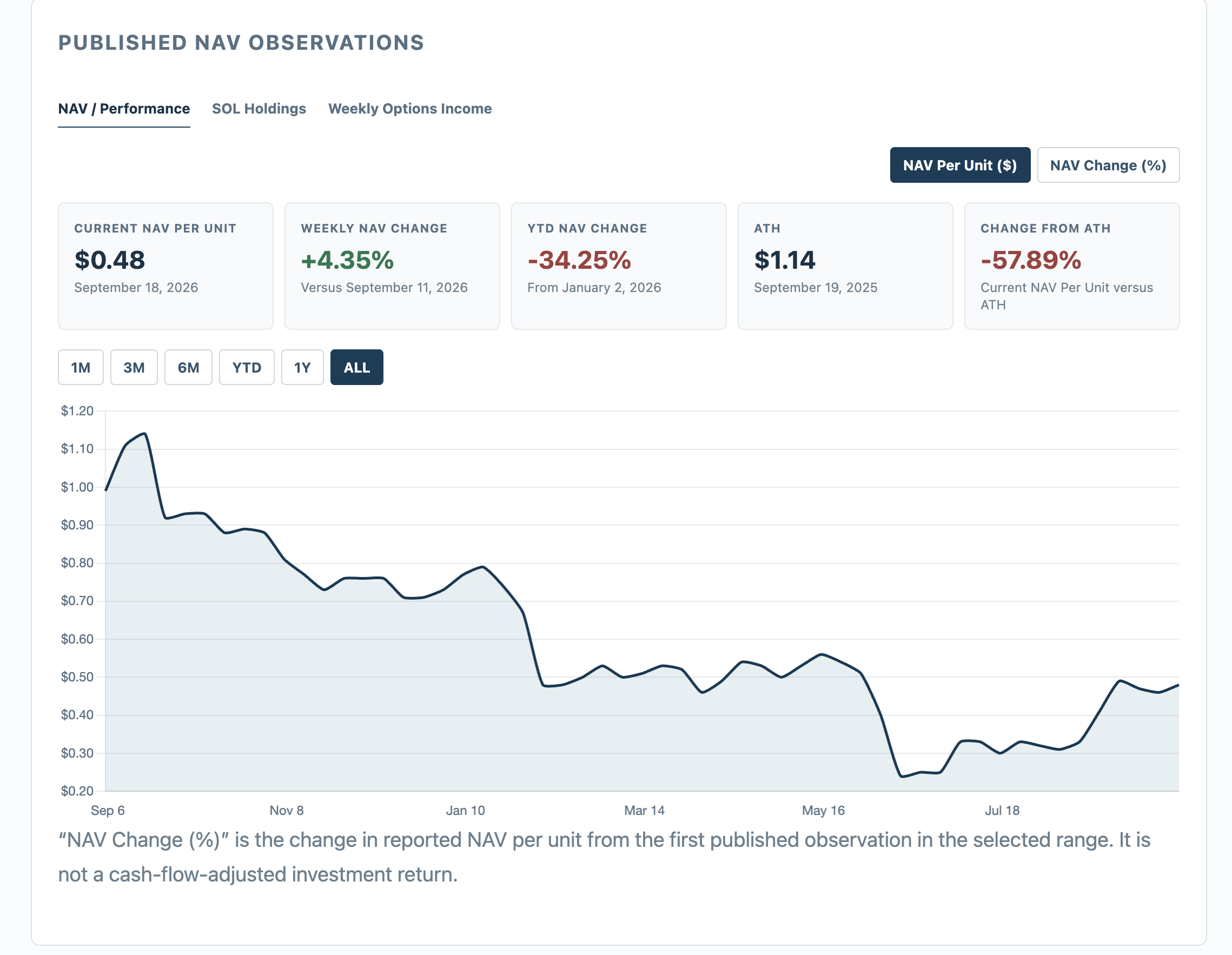
Early on, the objective was to compound a spot position rather than distribute an income stream. The launch journal entry recorded the September 4, 2025 start and an explicit focus on steadily growing the underlying SOL position. The original expectation was that a growing derivatives ecosystem would make the overlay progressively easier to manage. A year later, that expectation needs qualification.
In Episode 126, we recorded that our SOL calls had reached a point where suitable roll dates were limited. In Episode 143, our response was to keep calls limited because the position was well below its break-even and the premium available did not justify surrendering much recovery potential. That was not a prediction about SOL. It was portfolio triage: when we want to rebuild spot exposure, cheap upside caps are counterproductive.
The problem became more concrete in Episode 158. SOL had rallied from roughly $89 to $108, while our calls were challenged. We closed 16 SOL $84 calls because there were no suitable contracts available to roll up and forward. Rather than maintain the cap, we sold 16 $83 puts expiring at month-end. That exchanged capped spot upside for additional downside and assignment exposure. It was not a free improvement; it was the least objectionable available adjustment.
Episode 159 documented roll-forwards from end-September to end-October. The rolls collected time premium and could improve the structure, but they also extended the period in which upside was capped. The following week, Episode 160 rolled five $90 SOL calls to October 30 at a higher $95 strike. The higher strike required a small debit; five additional $120 calls were sold to make the combined adjustment a modest net credit. The mechanics worked, but they illustrate the compromise: a better strike was not simply available for free, and the solution extended the exposure.
Our latest record makes the assignment lesson unavoidable. In the unpublished September 2026 journal, 15 SOL were allowed to go at predefined $85 and $90 strikes after calls expired with SOL above them. We did not regard the original trades as automatically wrong. We did conclude that the chain did not offer a roll we considered attractive enough to preserve the underlying. The position fell below 60 SOL, while our stated long-term target remains at least 100 spot SOL. We chose to rebuild gradually rather than force a poor adjustment.
The covered-call problem: real premium, surrendered upside
A covered call is not a yield product that happens to hold SOL. It is a sale of upside above a chosen strike. The distinction is especially important for an asset that can move sharply.
Take a simple illustration. An investor owns SOL at $80 and sells a $90 call. If SOL drifts toward $90, the premium may be useful and the planned exit can be reasonable. If SOL jumps to $120, however, a $20, $30 or $40 premium looks small beside the $30 of appreciation above the strike that the seller has surrendered. The trade may still have followed its stated rules; it has simply exchanged a large upside outcome for a much smaller certain receipt.
In a deeper market, the seller may be able to buy back the old call and sell a higher, later one at a tolerable debit or credit. That is not a guarantee in BTC or ETH, but their larger chains normally provide more candidate strikes and dates. With SOL, thinner OTM and roll liquidity can leave three unattractive choices: accept assignment, buy back an expensive call, or extend much further out than intended. We discovered this the hard way.
The operating rule that follows is simple: selling a SOL covered call should mean being genuinely comfortable selling the SOL at that strike. Relying on the assumption that it can always be rolled later is dangerous.
SOL options versus BTC and ETH
| Practical dimension | SOL | BTC | ETH |
|---|---|---|---|
| Tracked market scale in our snapshot | $227m OI; $14m 24h volume; 4 venues | $41.26bn OI; $2.92bn 24h volume; 5 venues | $6.68bn OI; $1.27bn 24h volume; 5 venues |
| Expiry and strike choice | Weeklies exist, but useful choice can cluster | Deeper and more flexible | Deeper and more flexible |
| OTM quotes and size | Less reliable away from the centre | Generally broader | Generally broader |
| Entry and exit | Possible, but execution must be checked contract by contract | More robust across the chain | More robust across the chain |
| Rolling a challenged call | Often the limiting decision | Usually more alternatives, never guaranteed | Usually more alternatives, never guaranteed |
| Best fit | Selective assignment-ready trades | More suitable for systematic cycles | More suitable for systematic cycles |
The gap is not marginal. The same Loris snapshot placed SOL open interest at roughly 0.55% of BTC’s and 3.4% of ETH’s. It recorded 1,564 active SOL instruments versus 3,656 BTC and 3,410 ETH. Those figures do not measure every order book, but they support the broad conclusion from our trades: the underlying can be attractive while the options market remains less attractive for a roll-dependent strategy.
Reasons we still want to own SOL
- Network activity is real, even if it is uneven. Solana has a broad application and trading ecosystem. In the current DefiLlama chain view, DEX volume, fees, stablecoin activity and a large protocol set are visible alongside more speculative activity. We do not treat any one metric as a valuation model. We do see a network with actual economic use and infrastructure worth monitoring.
- It is high-beta exposure to crypto adoption. SOL has historically reacted strongly in risk-on periods. That creates meaningful upside potential if the ecosystem and broader crypto market develop well. It also creates a sizing problem: the same beta that attracts holders can make a small covered-call premium a poor exchange for a large move.
- There are several potential sources of utility. Staking, DeFi, payments, trading infrastructure and selective option premium can all be relevant. None is a free return. Staking has validator and protocol risk; DeFi introduces smart-contract, liquidity and counterparty risk; option premium is compensation for real downside, upside and execution risk.
Reasons an investor may reasonably decide not to own SOL
- Volatility can overwhelm the strategy. A covered call does not protect a holder when SOL falls sharply. Our own record includes long stretches in which the position remained below its cost basis despite premium collection. Position sizing matters more than annualised yield calculations.
- Competition and technology remain unresolved. Ethereum, Ethereum L2s and other high-throughput networks compete for users, liquidity, developers and applications. Solana also carries execution, infrastructure-concentration and operational risks. Network activity today is not a guarantee of durable dominance.
- Token valuation can diverge from use. SOL can reprice on risk appetite, liquidity, narratives and speculative trading, including memecoin cycles. Genuine network use does not tell us that the token is cheap, nor does it prevent a long period of weak price performance.
When SOL puts and calls make sense—and when they do not
Selling a cash-secured SOL put can make sense when we genuinely want to acquire SOL at the strike, collateral is available, the premium survives a realistic spread and we can hold through assignment. It is less sensible when the trade is merely a search for annualised yield or when an assignment would create an oversized position.
A SOL covered call can make sense when the selected strike is an honest planned sale price, the expiry and execution are acceptable, the position is small enough, and we do not require frequent rescue rolls. It becomes much more problematic when the plan depends on precise delta selection, narrow spreads, weekly recycling, short-duration alternatives or actively defending a call while refusing to sell the SOL.
For TerraMatris, the central portfolio conflict is clear. The stronger our conviction in owning and accumulating SOL, the weaker the case becomes for aggressively selling calls against it. We want to build at least 100 spot SOL. Repeatedly capping an asset we want to keep can directly undermine that objective. Premium available today is not a sufficient reason to take that trade.
What we are changing after one year
We remain interested in SOL and will probably continue to use options selectively. We are not treating the overlay as an automatic weekly income machine. We will put more weight on strike selection, liquidity at the actual roll candidates, position size and a genuine willingness to accept assignment. When the chain does not support those conditions, doing nothing is a valid decision.
The year changed our view without producing a simplistic verdict. SOL options have developed: access, venue count and listed contracts are better than the market we entered. What improved less dramatically in our own execution was the ability to move an existing position into the exact strike and expiry we wanted at an acceptable price. For BTC and ETH, the market often gives us several ways out. For SOL, that flexibility is still less reliable.
That is why our default is becoming more conservative. The premium is real. So is the upside we surrender. If we sell a SOL call, we should be prepared to deliver the SOL at its strike—not assume that a future roll will save a decision we would not otherwise accept.