Crypto had another strong but volatile week. From last Friday through Friday morning, Bitcoin moved from around $80,500 to roughly $84,500, Ethereum from around $2,610 to $2,690, while Solana moved from roughly $112 to $117.
The biggest move came early in the week. Bitcoin briefly pushed above $86,000, Ethereum traded above $2,800, and SOL approached $120 before the market cooled and gave back part of the gains.
The move came against a difficult macro backdrop. On September 16, the Federal Reserve raised its target range by 25 basis points to 3.75%–4.00%, while inflation remained elevated and Treasury yields continued to matter for risk assets.
Crypto nevertheless recovered strongly. Bitcoin led the move, while ETH and SOL followed. Improved market sentiment, institutional demand, ETF flows and short covering all contributed to the broader recovery. The regulatory backdrop also changed during the week, with the SEC introducing temporary exemptions designed to facilitate trading of certain tokenized U.S. stocks.
For our strategies, the important part was not simply that crypto moved higher. Volatility remained high enough to continue producing option premium while the underlying assets appreciated. That generally worked in our favor, although the strong SOL move also pushed several covered calls deep into the money and exposed the limitations of liquidity in Solana options.
Ethereum Strategy
The Ethereum strategy continued its structured short-put income cycle, with the focus remaining on premium generation and gradual accumulation of ETH.
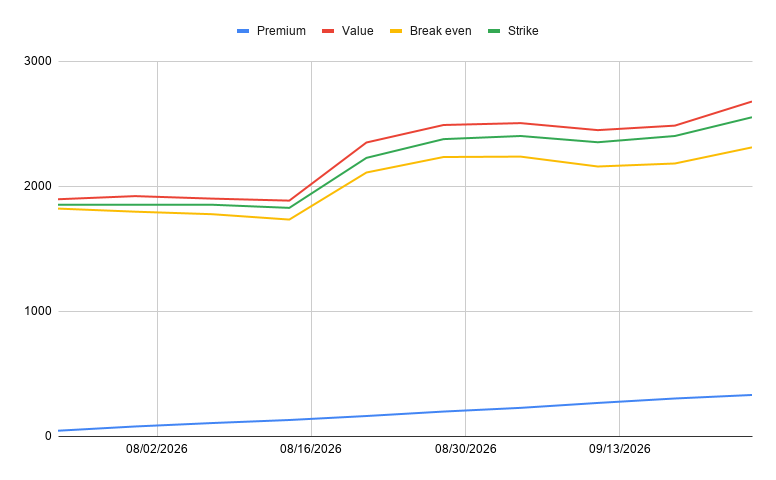
Our previous 1.4 ETH short put position expired worthless, allowing us to keep the full premium without taking assignment.
With ETH trading higher, we opened the next cycle:
- 1.4 ETH October 2, 2026 $2,550 cash-secured puts
- Premium: $20.90 per ETH
Gross premium from the new position was approximately $29.26 before commissions. Because ETH had moved higher, we increased the strike by $150 compared with the previous week. This allowed us to maintain a reasonable premium while keeping the position within the strategy's current risk parameters.
Current notional exposure is approximately $3,570.
Cumulative premium income in the current cycle has now reached approximately $328.20. Assuming the current puts expire worthless, that would represent about 9.19% of current notional exposure over 70 days.
The target for this cycle remains $400 in cumulative premium income. At the recent pace, we could reach that level within another two or three weeks, although assignment, volatility and changes in option pricing can easily alter that timeline.
Once the cycle is completed, the plan remains to allocate 50% of realized cycle profits toward TerraM token liquidity and buybacks.
The new puts were opened at approximately -0.20 delta. Delta is useful for understanding how sensitive the option is to changes in ETH and gives us a rough indication of how aggressive the strike is, but it should not be treated as a precise probability of assignment.
We also reinvested part of the week's premium into another 0.01049 ETH, increasing our long-term ETH holdings to approximately 0.156 ETH.
This remains an important part of the strategy. Premium is useful, but the longer-term objective is not simply to generate USD income. We also want the strategy to gradually build a larger underlying ETH position.
Solana Strategy
Our Solana strategy finished the week at $0.53 NAV per unit, representing a weekly gain of 9.5%.
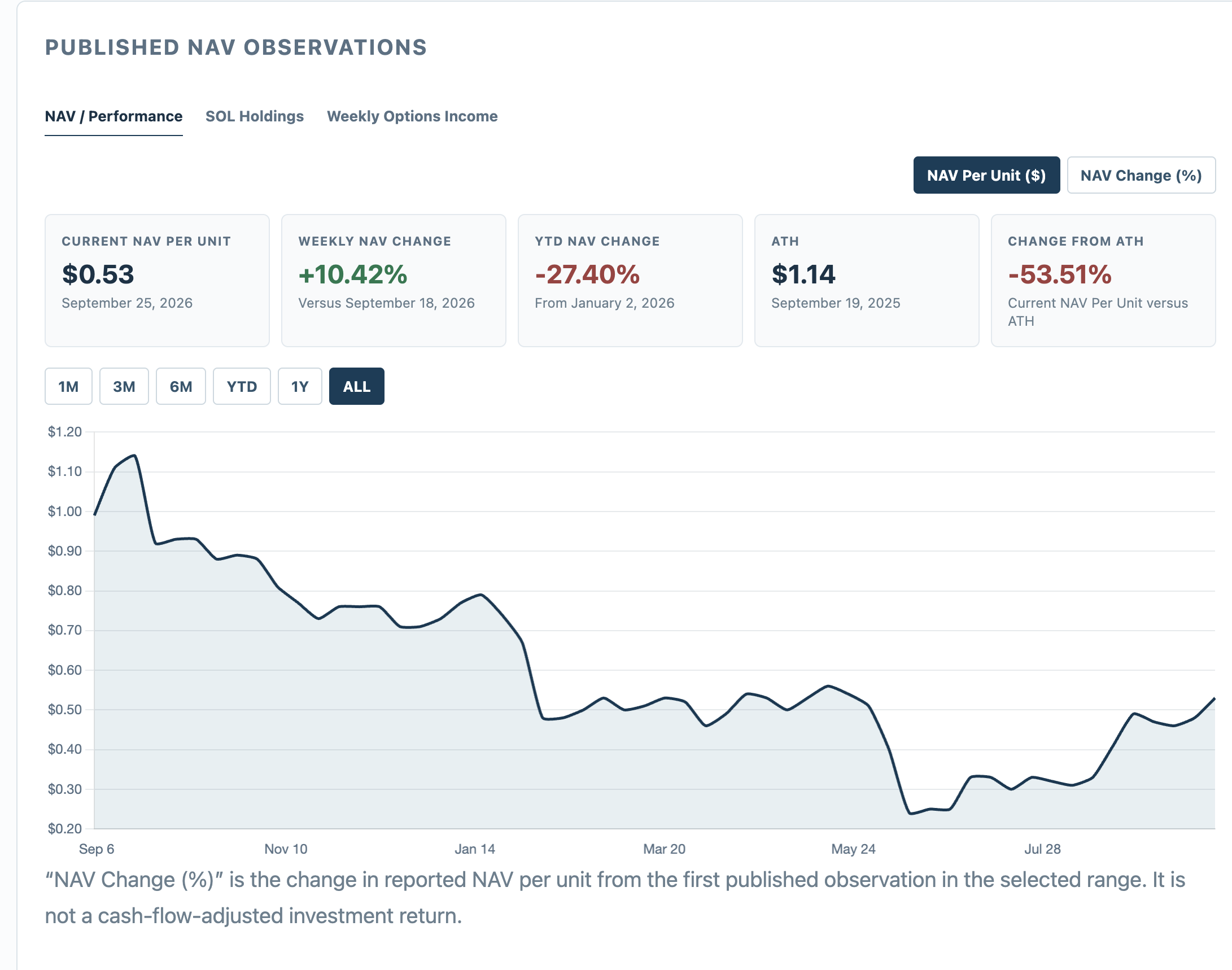
This was also an important expiry week for the SOL strategy. We had both puts and covered calls open, and SOL's strong move pushed several of those positions deep into the money.
Limited liquidity made rolling the covered calls unattractive. As a result, we allowed 15 SOL to be called away at our predefined strike prices of $85 and $90.
Why Rolling SOL Options Can Be More Difficult Than BTC or ETH
This illustrates one of the biggest practical drawbacks we have encountered with Solana options. The underlying asset can move quickly, but the options market remains considerably less liquid than BTC or ETH. A position can look manageable when it is opened, yet become difficult to roll efficiently when SOL makes a large move.
That does not necessarily mean we should stop selling SOL options. It does mean we need to be more selective about strikes, expiry dates and how much of our spot position we are willing to cover.
For the next cycle, we sold puts covering 25 SOL with an October 30 expiry and collected approximately $50 in gross premium before commissions.
Relative to the size of the position, this is not a particularly large premium. That is acceptable. Our priority remains staying structurally bullish on SOL and rebuilding the underlying position rather than maximizing short-term option income.
Because of the SOL called away this week, total holdings have now fallen below 60 SOL. That is below where we would like to be, as our longer-term target remains at least 100 spot SOL.
The current plan is therefore to add approximately 5 SOL per week between now and the October 30 expiry. This gives us a simple way to gradually rebuild the position rather than trying to buy everything back immediately after a strong rally.
The objective remains unchanged: use options to monetize SOL volatility while continuing to build meaningful long-term exposure to the underlying asset.
Bitcoin Strategy
Bitcoin created a different problem this week. Our $80,000 covered call was in the money as expiry approached, but we did not want to lose the underlying BTC.
Instead of allowing the position to be called away, we bought back the existing call and rolled the position higher and further out:
- Bought: Sep 25, 2026 $80,000 call @ 3,949
- Sold: Oct 30, 2026 $82,000 call @ 4,820
- Gross roll credit: approximately $8.71 on our 0.01 BTC position before commissions
The quoted option prices are before commissions, so the actual net credit will be slightly lower. On a gross basis, the difference between the two quoted option prices is 871 points, equivalent to approximately $8.71 on a 0.01 BTC position.
The roll accomplished two things at once: we increased the potential exit price from $80,000 to $82,000 while still receiving a small gross credit.
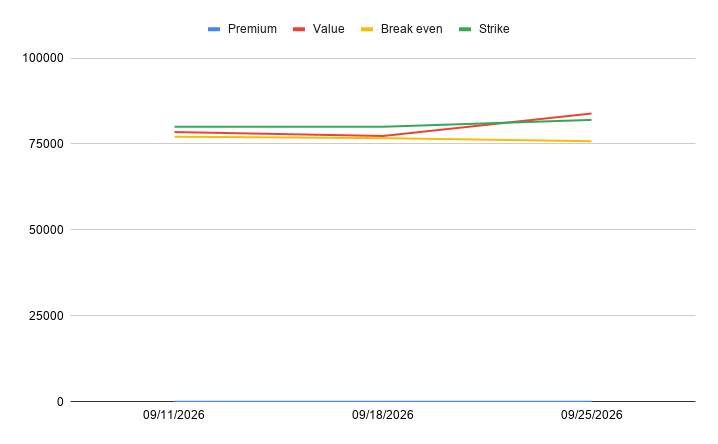
After accounting for the option premium collected so far, our estimated break-even on the BTC position is approximately $75,871.
If BTC remains above $82,000 at the October expiry and we eventually allow the position to be called away, the cycle would still produce a meaningful return. For now, however, the priority remains maintaining the underlying BTC exposure while improving the strike whenever the options market gives us a reasonable opportunity to do so.
There is one trade-off. Because the covered call has now been extended to October 30, our existing BTC is tied up for the next several weeks. We cannot simply sell another covered call against the same position.
If BTC continues trading above our $82,000 covered-call strike, we therefore plan to explore small defined-risk credit spreads next week as an additional source of premium.
Part of the latest premium was also reinvested into another 0.000099 BTC, increasing total spot holdings to 0.01032685 BTC.
As with ETH, this is the longer-term idea behind the strategy: use option income not only as cash flow, but also as a mechanism for gradually increasing the underlying crypto position.
TerraM Multi Asset
The TerraM Multi Asset portfolio gained another 3.27% this week and reached $4,699.
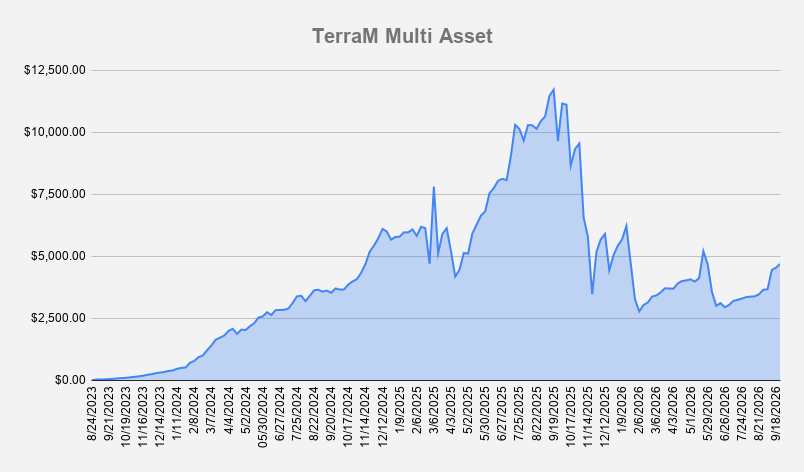
The improvement is encouraging, but it is important to keep it in perspective. The portfolio remains in recovery mode at approximately -12.74% YTD and roughly -59.9% below its September 2025 all-time high.
Based on this week's quoted option prices, the manual ETH and BTC strategies generated approximately $37.97 in gross option premium before commissions.
This consists of approximately $29.26 from the ETH short-put position and $8.71 from the BTC covered-call roll. The Solana strategy and the 1-DTE ETH bot are tracked separately and are not included in the TerraM Multi Asset premium figure.
More important than the weekly total is that both Ethereum and Bitcoin are now contributing option income independently while we continue accumulating the underlying assets.
No single week changes the bigger picture. The priority remains straightforward: protect capital, maintain strategy discipline, accumulate the underlying assets and allow option income to compound over time.
TerraM Token
TerraM remained relatively stable around the $0.77 level, with no significant trading activity recorded during the week.
We are not planning to force treasury activity simply to create volume.
The next planned treasury operation remains linked to completion of the current Ethereum income cycle. Once cumulative realized premium reaches the $400 target, the plan is to allocate 50% of completed cycle profits toward TerraM liquidity and token buybacks.
Based on the recent pace of ETH premium generation, that milestone could potentially be reached within another two to three weeks. The actual timing will depend on volatility, available premiums and whether we take assignment on the ETH puts.
1-DTE ETH Trading Bot
Our 1-DTE Ethereum trading bot reached another milestone this week: 83 completed trading days without a losing day recorded.
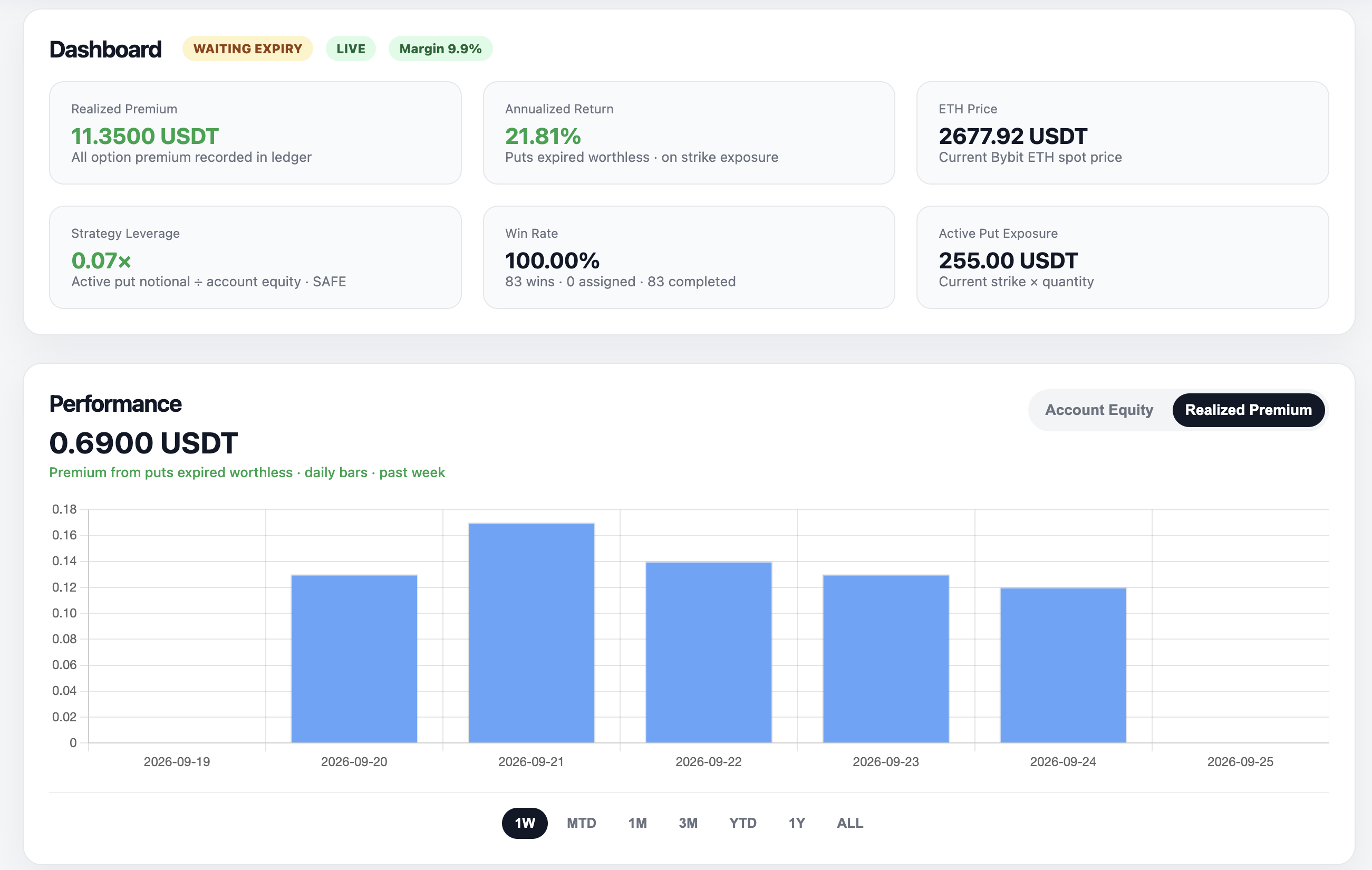
That is encouraging, but the sample remains relatively small and the strategy has not yet been tested through every possible market environment. In particular, a severe one-day ETH decline or sudden volatility spike remains the most important unresolved test.
It has also now been one week since we opened the bot to a small public beta for users interested in testing it. So far, we have not had any external users register.
We do not currently have a formal marketing plan for the beta. Apart from occasionally mentioning it in direct conversations within the Ethereum community, we are not actively promoting it.
And that is perfectly fine at this stage. There is little reason to force adoption before we have completed the initial validation period. For now, we are happy to let interest develop organically and see whether genuine users emerge over time.
Based on the results recorded so far, the strategy is running at an annualized return pace of approximately 21.86%. This is simply an annualization of the existing 83-day sample and should not be interpreted as a forecast of future returns.
During the latest week, the bot generated approximately $0.69 in premium income while trading 0.1 ETH short puts with a delta threshold below -0.06.
The bot is tracked separately from TerraM Multi Asset, so this premium is not included in the Multi Asset weekly premium figure.
Position sizing remains unchanged. We want the strategy to complete its initial 100-trading-day validation period before considering whether any parameters or position sizes should be adjusted.
The Bottom Line
This was a good week for the portfolio, but perhaps a more useful week for learning than the headline returns suggest.
Ethereum did what we want from the core short-put strategy: the previous position expired worthless, another premium cycle was opened, and part of the income was converted into additional ETH.
Bitcoin showed how an in-the-money covered call can be managed rather than immediately surrendering the underlying position. We moved the strike from $80,000 to $82,000, extended the expiry and still received a small gross credit before commissions.
Solana showed the other side of options trading. The underlying performed very well, but thin options liquidity made defending our covered calls difficult. We generated premium, but we also gave up some upside participation and had 15 SOL called away.
The 1-DTE bot continued its unbeaten run, but 83 trading days are still only an early sample. We are deliberately keeping position sizing unchanged until the initial 100-day validation period is complete.
The broader objective remains the same: build larger BTC, ETH and SOL positions over time while using options selectively to generate additional cash flow around them.
What We Are Watching Next Week
- Ethereum: whether ETH can remain comfortably above our October 2 $2,550 put strike. Another worthless expiry would move the current premium cycle closer to its $400 target.
- Bitcoin: whether BTC can hold above $82,000. If conditions are attractive, we will examine whether small defined-risk credit spreads offer enough premium to justify an additional position while the covered call remains open until October 30.
- Solana: rebuilding the spot position after 15 SOL were called away. The current plan is to add roughly 5 SOL per week while monitoring liquidity in the October options.
- Macro: Treasury yields, inflation expectations and expectations around the next Federal Reserve decision remain important for crypto and other risk assets.
- Crypto flows: whether institutional and ETF demand continues after Bitcoin's recent recovery.
- 1-DTE bot: continue trading the existing parameters without increasing size as the strategy moves closer to its 100-day validation milestone.
After the strong recovery of the last several weeks, we are not interested in chasing prices. The priority for the coming week is simpler: collect sensible premiums, rebuild positions where necessary, reinvest part of the income into the underlying assets and let the strategies continue doing their work.