The week ending October 9, 2026, brought a sharp change in mood across cryptocurrency markets. Bitcoin fell from the mid-$80,000s toward $80,400 during Thursday's sell-off before recovering some ground. Ethereum dropped toward $2,490, while Solana also weakened, briefly slipping below the $110 area.
The pressure was not confined to crypto. Rising oil prices amid Middle East tensions, higher US Treasury yields and a stronger dollar weighed on risk assets. As prices broke lower, forced closures of leveraged positions amplified the move. CoinDesk reported roughly $1.19 billion in cryptocurrency liquidations over 24 hours, including approximately $356 million in ETH positions and $298 million in BTC positions.
For TerraM, this was a useful stress test. Our weekly premium continued to arrive in several strategies, but falling underlying prices challenged short-put strikes, reduced portfolio values and put our automated trading infrastructure through its first full assignment cycle.
Ethereum Strategy
Our Ethereum strategy entered the week with 1.4 ETH of October 9 cash-secured puts at a $2,600 strike. As ETH sold off and those puts moved into the money, we chose to roll rather than wait for possible assignment at expiration.
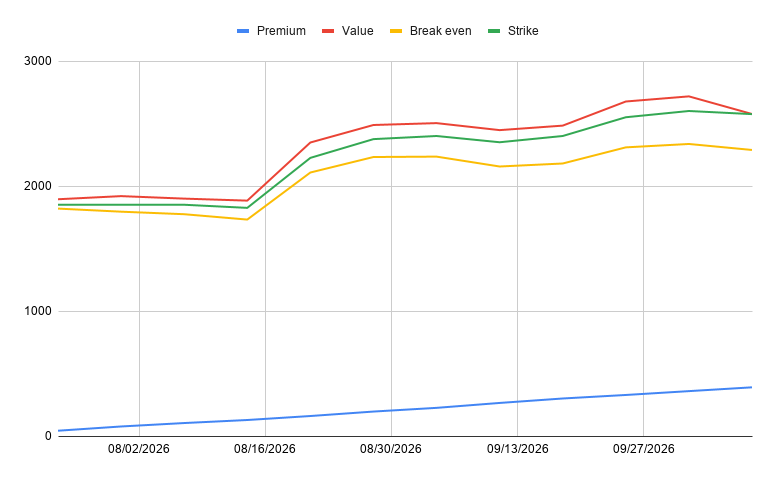
On Thursday, we executed the following adjustment:
- Bought to close 1.4 ETH October 9 $2,600 puts.
- Sold to open 1.4 ETH October 16 $2,575 puts.
The adjustment lowered the strike by $25, extended the position by one week and was completed for a net credit.
Assignment would have been a valid alternative within our strategy. We could have accepted ETH at $2,600 and started writing covered calls. Instead, the lower strike gave us a somewhat improved potential entry price and more time for the market to stabilize. Our new strike-based exposure is $3,605, compared with $3,640 before the roll. The new puts were opened at approximately -0.50 delta, reflecting substantial sensitivity to ETH prices rather than a low-risk probability of assignment.
The current income cycle has accumulated approximately $389 in option premium, just $11 short of our $400 target. Relative to the new strike notional, that cumulative premium is approximately 10.80% over the reported 84-day cycle; it is not a realized portfolio return. We may need at least another two weeks to complete the cycle, and possibly longer. If ETH remains below $2,575, a further roll may be costly or require additional time. A recovery toward or above that level would improve our flexibility, but neither an ETH rebound nor a favorable roll is guaranteed.
For that reason, we are not increasing the manual position size while the existing 1.4 ETH exposure remains unresolved. We also reinvested part of this week's premium into another 0.01217 ETH, bringing our separate long-term ETH holdings to approximately 0.279 ETH. Once the cycle is genuinely completed and results can be assessed, we intend to direct 50% of realized cycle profits toward TerraM token liquidity and buybacks.
Solana Strategy
Our Solana Covered Call Growth Fund, which is separate from the TerraM Multi Asset portfolio, finished the week at a $0.50 NAV per unit, down 8.07% from the previous week's level. The decline reflects the difficulty of running a long-SOL strategy while the underlying asset is falling.
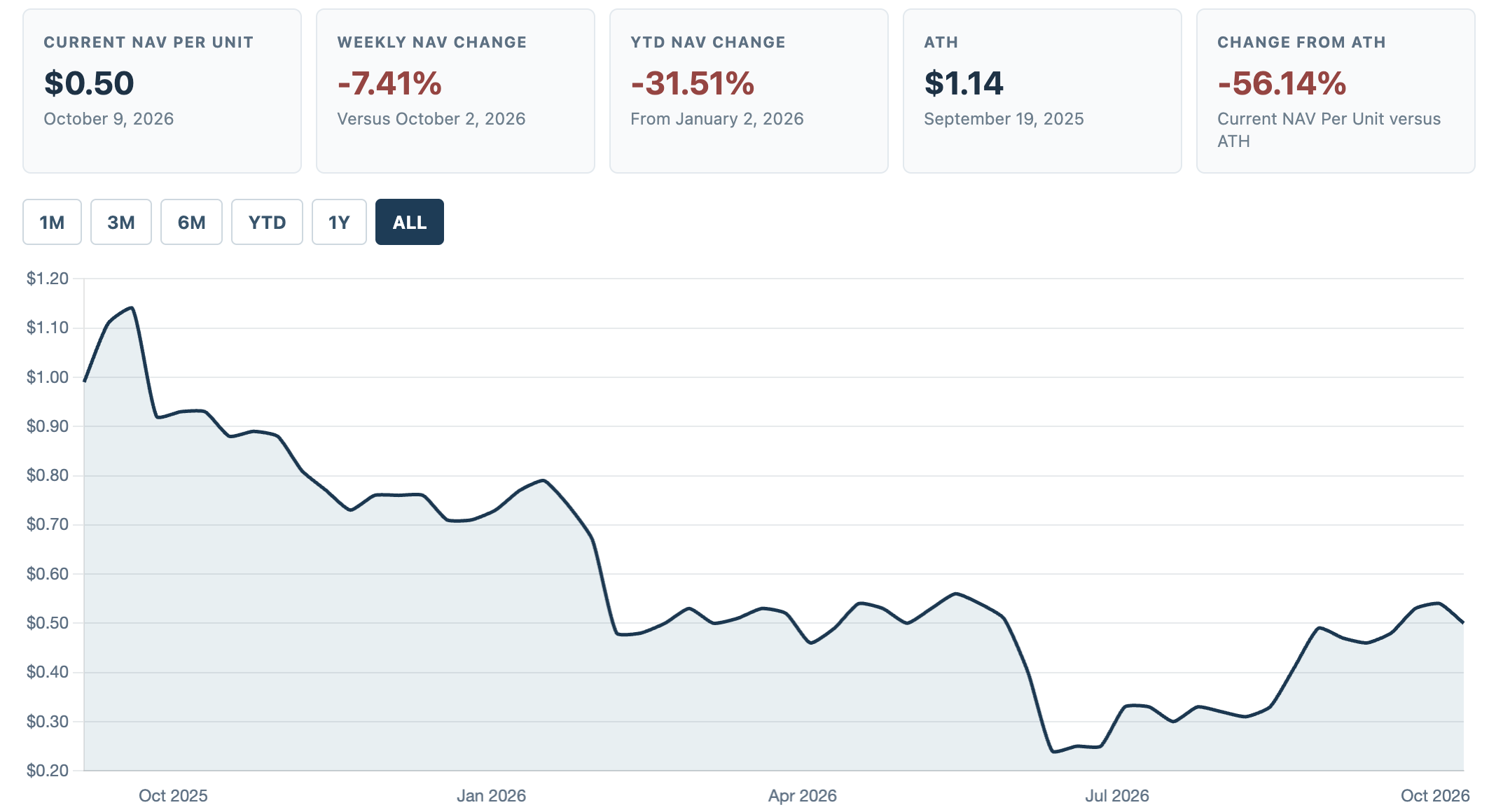
We nevertheless increased holdings to 69.33 SOL and generated $12.07 in options premium during the week. Our longer-term objective is to accumulate at least 100 SOL, while generally writing covered calls at strikes above the relevant break-even or purchase levels, currently quoted at $150.53 and $178.21.
With SOL trading around $110 during the sell-off, these levels remain some distance away. Lower prices may help reduce the average cost of future acquisitions, but they also mean the fund must absorb mark-to-market losses in the meantime. We will continue accumulating selectively without forcing below-cost covered calls simply to increase short-term premium income.
Bitcoin Strategy
Bitcoin's decline nearly challenged our put credit spread, but the position ultimately expired worthless, allowing us to retain the premium received. We then continued with our separate accumulation plan: working toward 0.1 BTC through purchases of roughly 0.01 BTC per month, funded primarily with fresh capital.
This week we bought another 0.01 BTC at $82,500, bringing total holdings slightly above 0.02 BTC. Because the incoming USDC had not yet settled when we placed the trade, we temporarily used margin to finance the new spot position. This introduces funding and liquidation risk until the funds arrive, so it should not be confused with a fully cash-funded purchase.
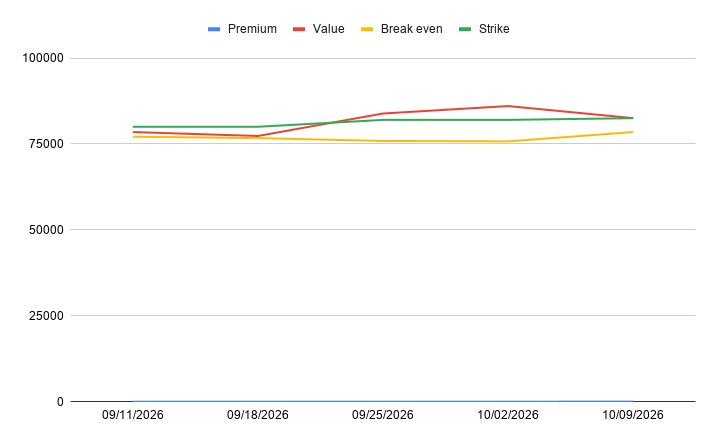
Against the new position, we executed the following buy-write:
- Bought 0.01 BTC at $82,500.
- Sold to open 0.01 BTC October 16, 2026 $83,000 covered call at $1,300 per BTC.
On a 0.01 BTC position, that is $13 in gross premium, or about 1.58% of the $825 purchase cost over seven days, before trading fees and financing costs. If the call is exercised at $83,000, the new 0.01 BTC position would also generate $5 of price appreciation, bringing the maximum gross profit for that buy-write to $18, or 2.18%. That calculation does not protect us from losses if BTC falls.
We would prefer to roll the call forward if the strike is challenged, particularly if it is possible to improve the strike without taking on disproportionate cost or risk. Rolling is a management preference, not a guarantee that we can prevent BTC from being called away. The $13 premium has been earmarked for further BTC accumulation: at $82,500 per BTC, it is equivalent to approximately 0.00015758 BTC, although the precise amount actually acquired depends on the reinvestment execution and fees.
TerraM Multi Asset
The TerraM Multi Asset portfolio fell 3.73% this week to a reported NAV of $4,613. It remains in recovery mode, at approximately -14.33% year to date and around -60.63% below its September 2025 high.
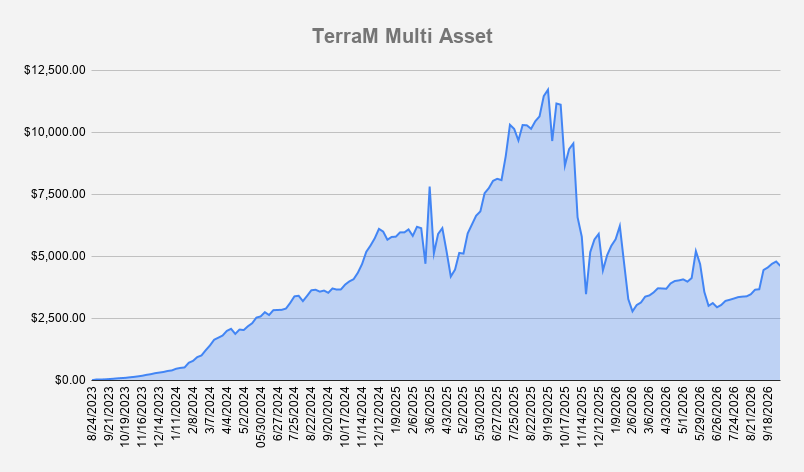
We are awaiting approximately $825 of additional capital expected to reach the account next week. That deposit would increase the account's total value, all else equal, but would not constitute an investment return. We will continue separating new contributions from trading P&L when evaluating progress.
Based on this week's quoted figures, the manual ETH and BTC strategies generated approximately $43.15 in net options premium after commissions, an amount equivalent to roughly 0.93% of the currently reported account size. It is a premium-flow comparison, not the portfolio's weekly total return, and should not be mechanically annualized.
TerraM Token
TerraM traded around $0.77, with no significant activity recorded this week. The next planned liquidity and buyback allocation remains linked to the manual ETH cycle. Reaching $400 of cumulative premium alone is not enough: we first need to resolve the open risk and determine the cycle's realized result before making the treasury allocation.
Ethereum Options Trading Bot
Our 1-DTE ETH options trading bot encountered its first assignment on day 93, taking delivery of 0.1 ETH at $2,640. A short-put delta around -0.06 had appeared conservative during the earlier run of trades, but this week's rapid move demonstrated that a low delta does not eliminate tail risk or assignment.
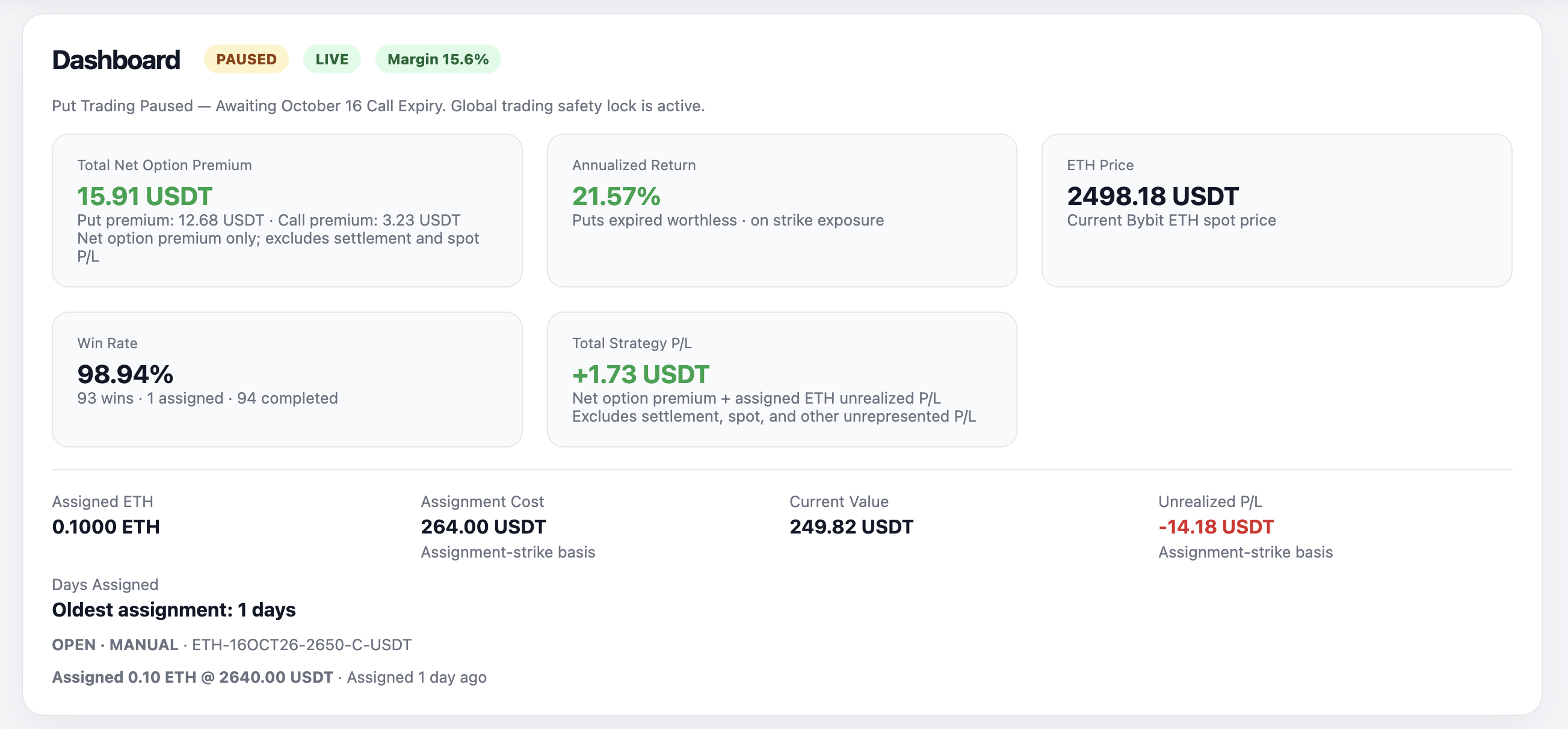
The assignment itself was part of the intended wheel strategy. The more important problem was operational: our automated transition from short puts into spot ownership and covered-call management on Bybit was not yet robust enough. We found and worked through issues in the position lifecycle, order handling and reporting, but did not consider the automated wheel cycle proven.
To keep the position managed, we manually executed the following covered call:
- Underlying position: 0.1 ETH assigned at $2,640.
- Sold to open 0.1 ETH October 16, 2026 $2,650 covered call.
- Premium received: almost $3.
This was more than three times the bot's usual weekly premium of approximately $0.70, though it covered a longer period and should not be taken as evidence of superior risk-adjusted performance.
The experience has changed our near-term development priorities. With such a small live position, there is little benefit in aggressively expanding public bot access before the settlement, assignment, covered-call and wheel-restart logic have passed end-to-end testing. We also want to compare 1-DTE against longer expirations using net performance, drawdowns, transaction costs and operator intervention—not premium alone. For now, we are prioritizing stability over user growth and postponing further scaling while we observe the next expiry.
Bottom Line
This was a difficult week for market value, but a valuable one for testing our process. Our manual ETH position remains open and in need of management; the Bitcoin portfolio accumulated additional spot exposure while the latest buy-write generated premium; the standalone Solana fund continued building inventory despite a declining NAV; and the bot's first assignment revealed important gaps between a successful put-selling routine and a fully reliable wheel system.
Our objective is not to maximize the number of trades or to present incoming capital as profit. It is to build strategies that can survive unfavorable markets, account honestly for their results, and operate with manageable risk as capital grows.
What We Are Watching Next Week
- ETH and the $2,575 strike: whether the market rebounds sufficiently to let us expire or adjust our 1.4 ETH short puts without taking on unnecessary additional exposure.
- Bitcoin's recovery and our $83,000 call: whether our newly added BTC remains covered through October 16, and whether a roll becomes appropriate if the strike is challenged.
- SOL price and cost basis: whether accumulating toward 100 SOL improves our longer-term position without compromising the fund's approach to covered-call strikes.
- USDC settlement and capital reporting: closing the temporary funding gap and recording the expected $825 contribution separately from trading results.
- Bot reliability: validating assignment reconciliation, spot balances, covered-call expiration, and the eventual return to put writing before considering higher position sizes or additional external users.
We enter the next week with clear positions to manage and several technical lessons to apply. The priority remains disciplined execution, not forcing a quick recovery.