Crypto markets were relatively resilient over the past week despite a challenging macro environment. Bitcoin spent most of the week around the mid-$80,000s, Ethereum remained close to $2,700, while Solana consolidated around the $120 area after its recent recovery.
Bitcoin finished the period slightly higher, while ETH was broadly flat. SOL also moved mostly sideways after a much stronger recovery earlier in September. For our strategies, this relatively contained price action was constructive: it allowed time decay to continue working in our favor without forcing major adjustments to the existing option positions.
The bigger story remained outside crypto. U.S. Treasury yields climbed above 5.2%, keeping pressure on risk assets as markets continued to debate the path of Federal Reserve policy. The Fed raised interest rates by 25 basis points in September, while persistent inflation, strong economic activity and rising energy prices continue to complicate the outlook.
There was some relief later in the week as U.S. PCE inflation came in softer than expected, reducing expectations for another immediate Fed rate increase. At the same time, geopolitical tensions around Iran and the Middle East continued to support elevated oil prices, adding another potential source of inflation and market volatility.
Overall, crypto handled the difficult macro backdrop reasonably well. We did not see a major breakout in BTC, ETH or SOL, but equally important for our option-selling strategies, we also avoided a significant market correction.
Ethereum Strategy
The Ethereum strategy continued its structured short-put income cycle, with the focus remaining on premium generation and gradual accumulation of ETH.
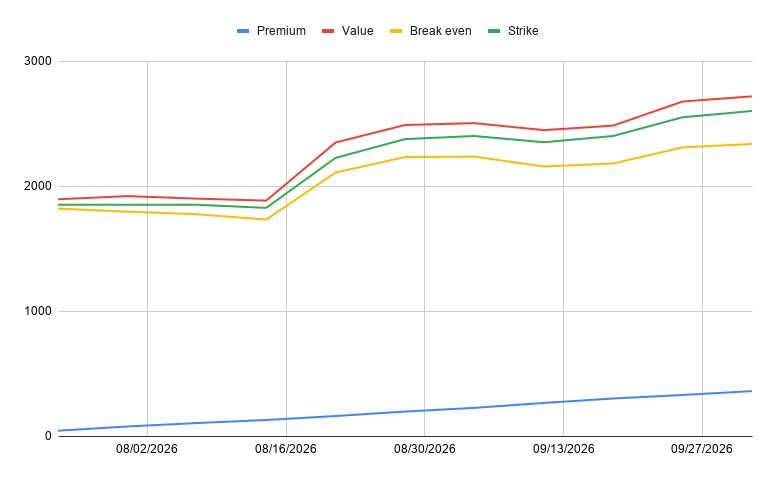
Our previous 1.4 ETH short put position expired worthless, allowing us to keep the full premium without taking assignment.
With ETH trading higher, we opened the next trade in the current cycle:
- 1.4 ETH October 9, 2026 $2,600 cash-secured puts
- Premium: $22.80 per ETH
Net premium from the new position was approximately $30.78. Because ETH had moved higher, we increased the strike by $50 compared with the previous week. This allowed us to maintain a reasonable premium while keeping the position within the strategy's current risk parameters.
Current notional exposure is approximately $3,570.
Cumulative premium income in the current cycle has now reached approximately $364. Assuming the current puts expire worthless, that would represent about 9.86% of current notional exposure over 77 days.
The target for this cycle remains $400 in cumulative premium income. At the recent pace, we could reach that level within another one to three weeks, although assignment, volatility and changes in option pricing can easily alter that timeline.
Once the cycle is completed, the plan remains to allocate 50% of realized cycle profits toward TerraM token liquidity and buybacks.
The new puts were opened at approximately -0.21 delta. Delta is useful for understanding how sensitive the option is to changes in ETH and gives us a rough indication of how aggressive the strike is, but it should not be treated as a precise probability of assignment.
We also reinvested part of the week's premium into another 0.01128 ETH, increasing our long-term ETH holdings to approximately 0.167 ETH.
This remains an important part of the strategy. Premium is useful, but the longer-term objective is not simply to generate USD income. We also want the strategy to gradually build a larger underlying ETH position.
Solana Strategy
Our Solana strategy finished the week at $0.54 NAV per unit, representing a weekly gain of 1.89%. 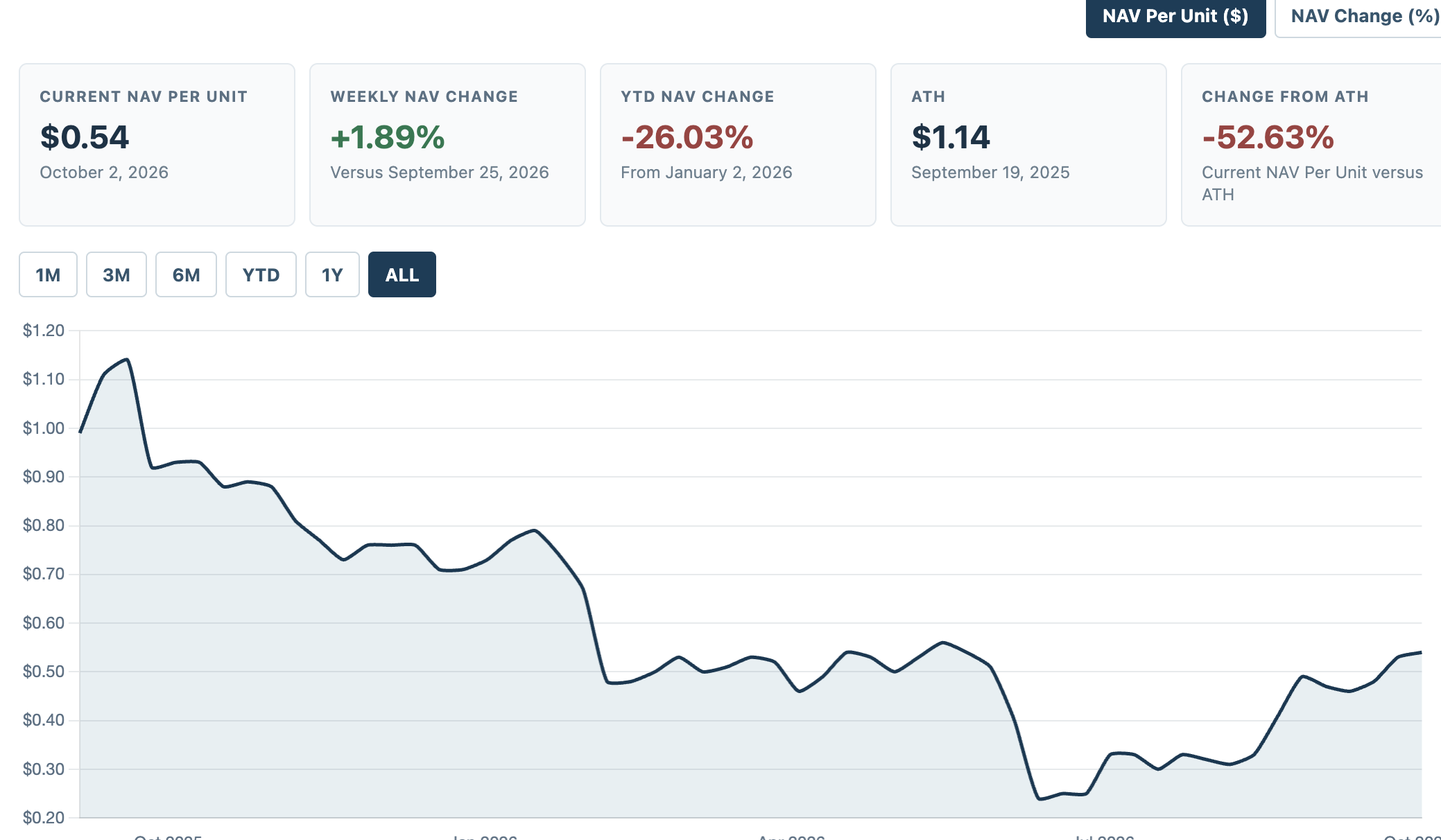
As of writing, SOL is trading around $121, representing a significant recovery for our position. However, it remains well below our current break-even level of approximately $155. Recovering that gap will likely take weeks or even months, assuming the broader crypto market remains constructive and does not experience another major downturn.
This week's liquidity work also reinforced a practical point from our SOL options experience: thin books can make a position difficult or expensive to adjust or roll even when the opening quote looked acceptable.
Bitcoin Strategy
For our Bitcoin strategy, we introduced a small 0.01 BTC $82,000/$80,000 weekly put credit spread expiring next week. The approximately $1.45 net premium is not meaningful income by itself. This is a deliberately small defined-risk experiment around BTC we already hold under the existing covered-call structure: we want to test whether another defined-risk layer can be managed sensibly before treating it as a broader part of the strategy.
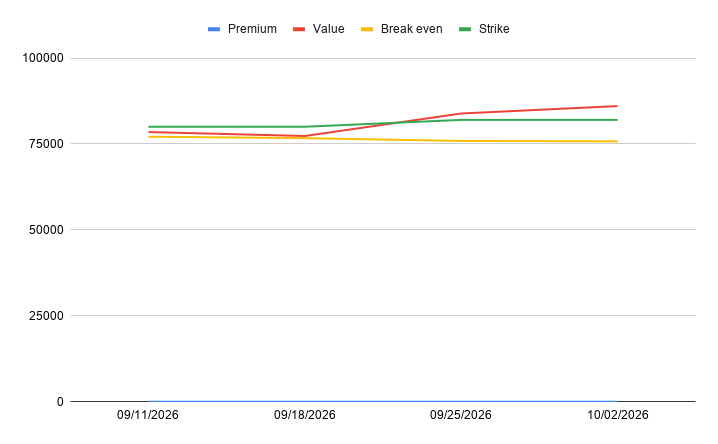
At the same time, we are gradually building our spot position toward the 0.1 BTC target through monthly purchases. We expect to add another 0.01 BTC to the strategy within the next two weeks.
Since we already hold an October 30 covered call, the larger BTC position should allow us to generate additional options premium toward the end of the month while continuing to build the underlying position.
In the meantime, we are essentially picking up pennies in front of a steamroller. More seriously, the spread defines the downside of the spread itself; it does not materially protect the BTC spot holding against a broad BTC decline. We expect to test credit spreads across broader positions only over time, after the strategy and capital base have grown significantly.
Part of the latest premium was also reinvested into another 0.000014 BTC, increasing total spot holdings to 0.01034074 BTC.
TerraM Multi Asset
The TerraM Multi Asset portfolio gained another 1.99% this week and reached $4,792.
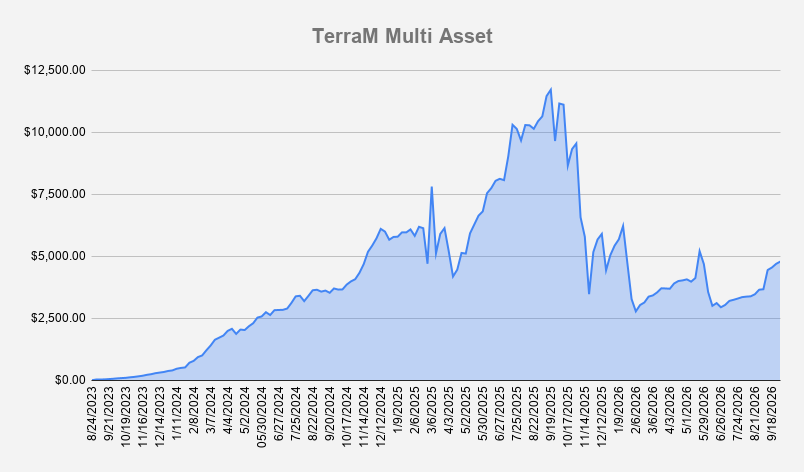
The improvement is encouraging, but it is important to keep it in perspective. The portfolio remains in recovery mode at approximately -11% YTD and roughly -59.11% below its September 2025 all-time high.
Based on this week's quoted option prices, the manual ETH and BTC strategies generated approximately $32.03 in net option premium after commissions, roughly a 0.66% observation relative to the current account size for the period. We are not mechanically annualizing that single week: premium collected, realized profit, NAV, contributed capital and actual portfolio return are different measures.
TerraM Token
TerraM remained stable around the $0.77 level, with no significant trading activity recorded during the week.
The next planned treasury operation remains linked to completion of the current Ethereum income cycle. Once cumulative realized premium reaches the $400 target, the plan is to allocate 50% of completed cycle profits toward TerraM liquidity and token buybacks.
Those buybacks and liquidity contributions are treasury and capital-allocation decisions. They should not be read as proof that TerraM demand has been solved, a guaranteed benefit to token holders or an entitlement to strategy profits.
We are very close to reaching this target, potentially as early as next week. However, we do not rule out the possibility that it could take a little longer.
First, we need roughly $38 in options premium to expire worthless. Since our typical weekly premium is slightly below that level, a more realistic expectation is that it may take another two to three weeks to complete the current cycle.
Ethereum Trading Bot
Our Ethereum trading bot reached another milestone this week: 89 completed trading days without a losing day recorded.
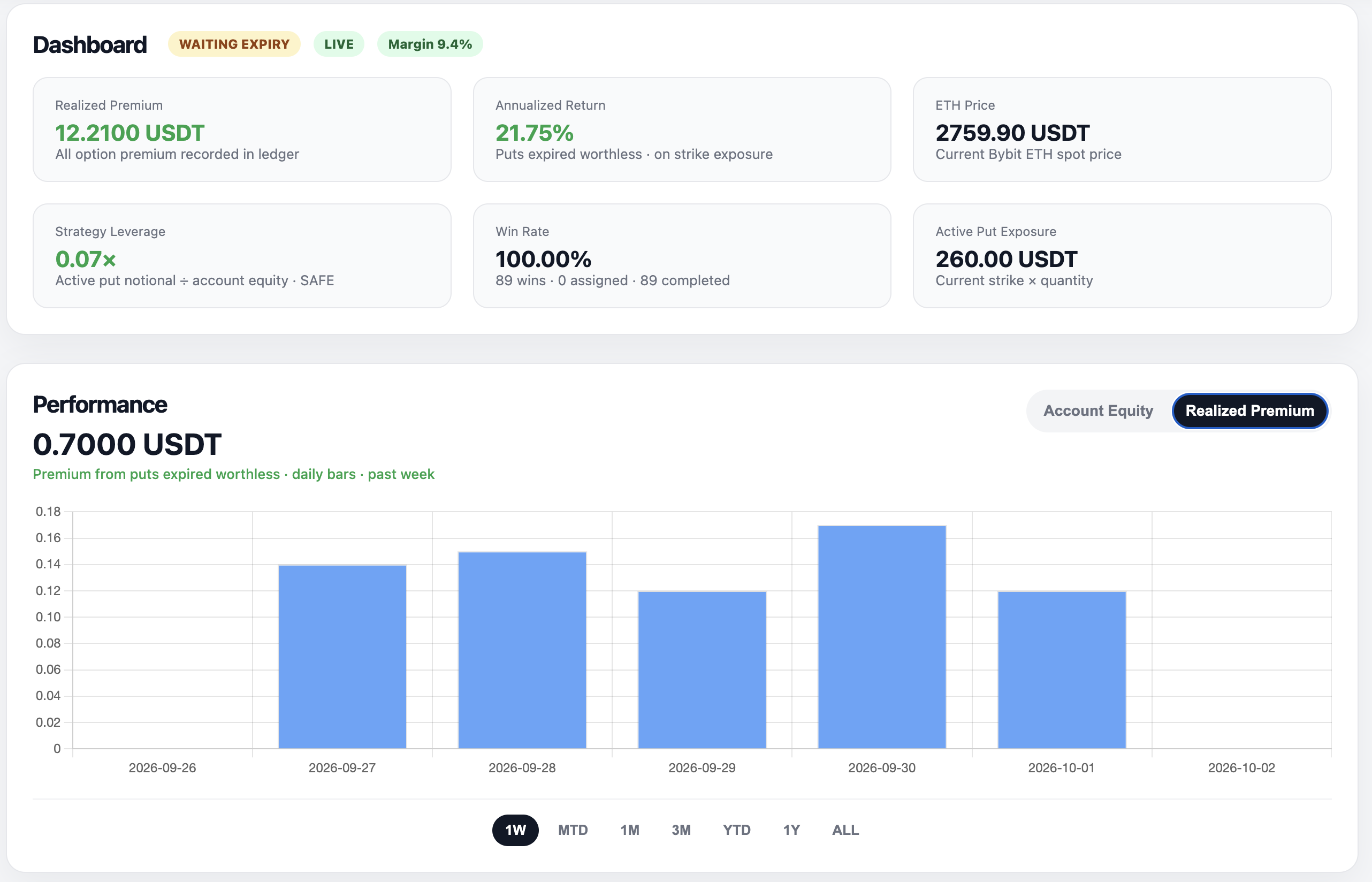
The more useful fact at this stage is the 89-day recorded test sample. Its results can be represented as an approximately 21.75% annualized pace, but that is only a mathematical representation of this limited sample, not an expected forward return.
During the latest week, the bot generated approximately $0.7 in premium income while trading 0.1 ETH short puts with a delta threshold below -0.06.
We are slowly approaching the bot's first 100-day testing milestone, after which we plan to scale the strategy by adding another 0.1 ETH within the next two weeks.
For now, we are not looking to increase the bot's risk parameters, such as using a higher delta. The priority remains reaching the first 100-day milestone and scaling the position only while keeping the existing risk profile unchanged.
Bottom Line
This was another constructive week for the portfolio. The Multi Asset NAV improved, the Ethereum income cycle moved closer to its $400 target, SOL continued its gradual recovery, and we introduced defined-risk Bitcoin credit spreads as another potential source of incremental premium.
Just as importantly, we continued accumulating the underlying assets. Both ETH and BTC option income was partially reinvested back into spot positions. This remains central to the longer-term strategy: generate premium today while gradually increasing the amount of productive crypto assets we can use tomorrow.
We are not looking to accelerate risk simply because recent results have been encouraging. The ETH position remains at 1.4 ETH for the current cycle, the trading bot continues using its conservative delta threshold, and the new BTC credit spread is deliberately small. Scaling should come primarily from a larger capital base rather than from materially increasing risk per dollar of capital.
What We Are Watching Next Week
- Ethereum: The main event for us is the October 9 expiry of the 1.4 ETH $2,600 puts. A worthless expiry would move the current income cycle very close to the $400 target.
- Bitcoin: We will follow the first weekly credit spread through expiry and continue preparing for the planned addition of approximately 0.01 BTC to the underlying position.
- Solana: We want to see whether SOL can hold its recent recovery around the $120 area. The position remains well below our approximately $155 break-even, so this is still a recovery process rather than a completed turnaround.
- Interest rates: Treasury yields remain one of the most important macro risks for crypto. Another sharp move higher in long-term yields could pressure BTC, ETH and SOL even without any crypto-specific negative news.
- Federal Reserve: Minutes from the September FOMC meeting are due on October 7 and may give markets more information about how policymakers are thinking about inflation and additional rate increases.
- U.S. economy: ISM Services data arrives on October 5, followed by U.S. trade data on October 6. With the next CPI report not scheduled until October 14, rates and Fed expectations may remain the dominant macro drivers.
- Oil and geopolitics: Elevated oil prices and developments around Iran and the broader Middle East remain potential volatility triggers. Any renewed energy-price spike could quickly feed back into inflation expectations and bond yields.
For now, there is no reason to force additional exposure. The immediate objective is straightforward: allow the existing positions to work, complete the current ETH cycle, continue accumulating BTC and ETH, and scale only as the capital base grows.