At Terramatris, we continue to explore systematic approaches to generating income from cryptocurrency markets without relying exclusively on directional price appreciation.
Our primary focus remains options-selling strategies across Ethereum, Bitcoin, and Solana. However, as our multi-asset infrastructure develops, we are increasingly interested in identifying additional sources of recurring income that can complement our existing trading cycles.
On October 18, 2026, we initiated a new EGLD funding rate arbitrage position on Bybit, combining a spot purchase of 150 EGLD with a corresponding short position in EGLDUSDT perpetual futures.
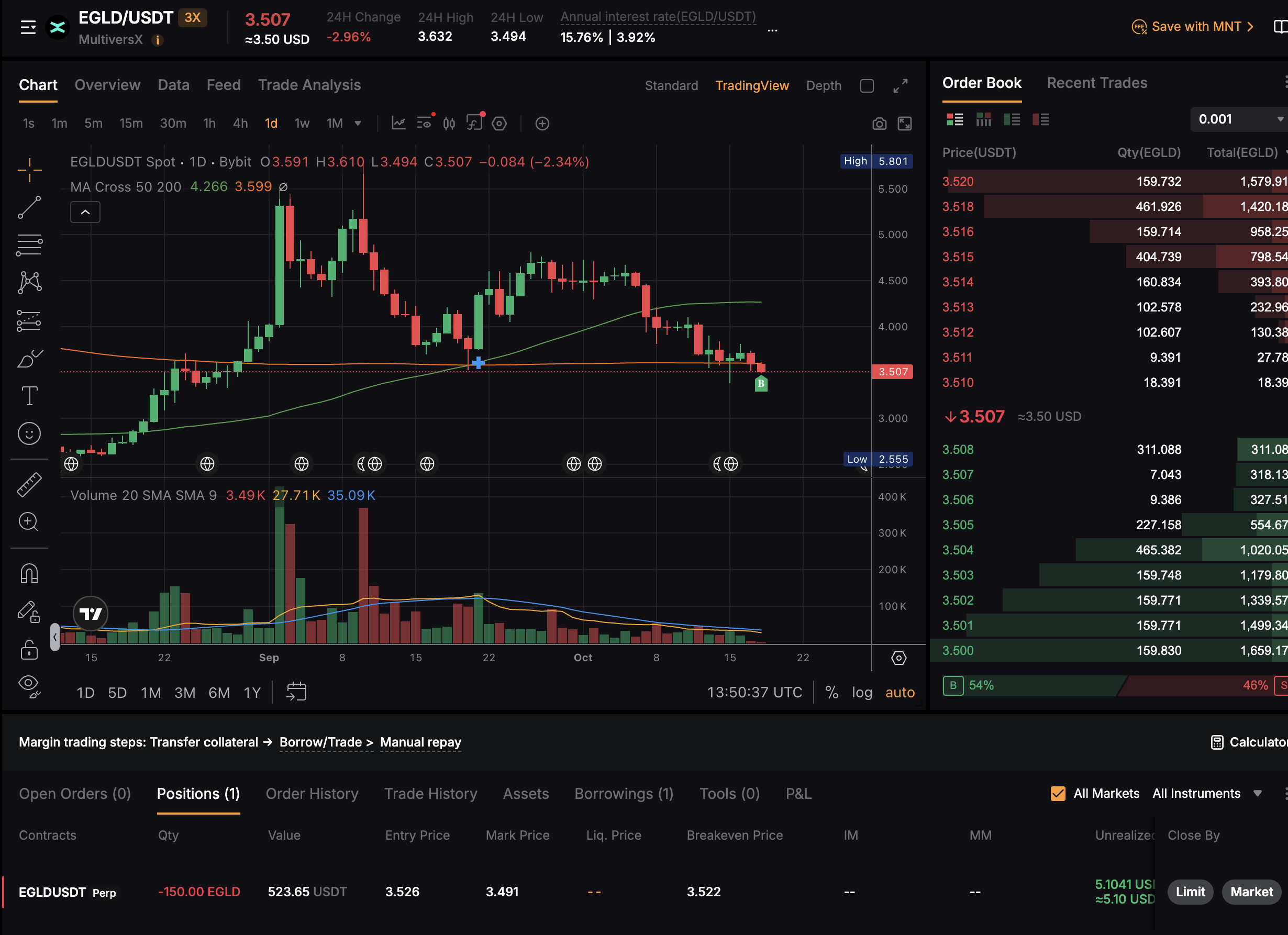
The experiment introduces an additional component: USDT financing at an indicated 3.91% annualized borrowing rate, compared with an assumed gross funding yield of approximately 16% APR.
The objective is to evaluate whether the difference between funding income and borrowing costs can generate a sustainable positive return after accounting for trading commissions, basis movements, margin requirements, and other expenses.
We are not positioning this as an active short-term basis-trading strategy. There is no predetermined closing date, and we are not attempting to profit primarily from convergence between spot and perpetual prices.
Instead, this is a long-term funding-income experiment, with a particular interest in whether relatively small amounts of recurring USDT income can contribute to the broader Terramatris ecosystem.
Importantly, we intend to direct 90% of any realized net funding-strategy profits toward the TerraM token or TerraM Multi Asset strategy, subject to the strategy's profitability, available capital, and risk requirements.
Although the amounts involved are initially expected to be modest, this creates an additional potential source of funding for our ecosystem.
From an AI-Powered Trading Bot to a Simple Manual Trade
When we first decided to revisit cryptocurrency funding rate arbitrage, our ambitions were considerably more technical than the trade we eventually executed.
The original idea was to develop a fully automated, AI-assisted funding rate scanner capable of monitoring hundreds of cryptocurrency pairs across Bybit, identifying attractive opportunities, calculating annualized funding yields, and eventually executing hedged positions automatically.
We actually made considerable progress.
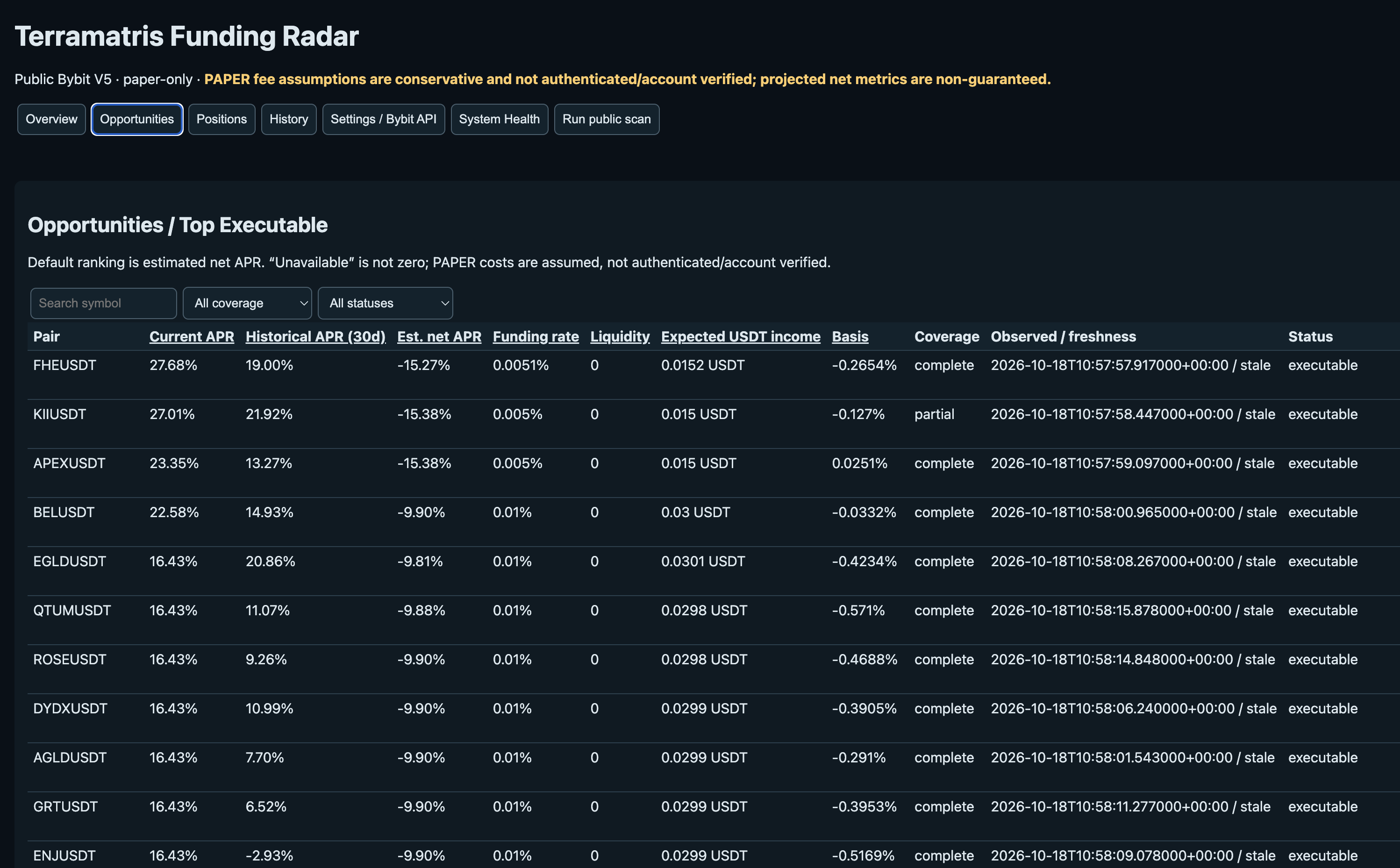
With the help of AI agents, we developed a local market-scanning application, introduced historical funding analysis, modeled trading fees and execution costs, and began building the infrastructure for automated trade execution and position monitoring.
The system was designed to identify opportunities, buy the underlying cryptocurrency on the spot market, and simultaneously establish an equivalent short position in perpetual futures.
However, somewhere along the development process, we arrived at a rather practical conclusion.
The actual trade is so simple to establish manually that building a sophisticated execution bot may be unnecessary, at least at our current scale.
Buying 150 EGLD on the spot market and shorting the same quantity through perpetual futures takes only a few actions on Bybit. Developing, maintaining, securing, and monitoring an automated execution system introduces its own operational complexity, particularly when the strategy is intended to hold positions for extended periods rather than trade frequently.
Automation makes considerably more sense when execution frequency, position complexity, or scale justifies the additional infrastructure.
For now, we have therefore paused development of the automated execution bot.
That does not mean abandoning artificial intelligence.
Quite the opposite.
We continue using AI agents to monitor funding rates, analyze historical yields, evaluate potential market entries, and compare the economics of different opportunities. We believe AI can deliver more immediate value in research, market surveillance, and decision support than in automating a trade that only needs to be executed occasionally.
Interestingly, it was one of these AI-assisted market scans that brought EGLD to our attention.
And here comes the slightly embarrassing part: before identifying the opportunity, we knew practically nothing about EGLD.
Probably not the strongest foundation for conventional investment advice. Ha!
But this also illustrates an important distinction between directional investing and funding rate arbitrage.
In a conventional long position, the investment thesis might depend heavily on the project's technology, adoption, token economics, or prospects for price appreciation.
In a market-neutral funding strategy, our primary objective is different.
We are not buying EGLD because we expect the token to appreciate. We are purchasing the underlying asset to offset an equivalent short perpetual position, with the intention of collecting funding payments while maintaining approximately neutral directional exposure.
That shifts much of our research attention toward the mechanics and reliability of the trade itself.
In particular, we are concerned with exchange counterparty risk, custody arrangements, liquidity, borrowing conditions, collateral requirements, funding-rate persistence, and the possibility of operational failures or security incidents.
A cryptocurrency exchange hack, withdrawal suspension, unexpected change in margin requirements, or failure of the hedge could have a much more significant impact on this strategy than an ordinary daily price movement in EGLD.
Nevertheless, market neutrality does not eliminate the need to understand the underlying asset. Token liquidity, delisting risk, extreme price movements, and disruptions to perpetual trading can all affect the hedge, especially when leverage and borrowed funds are involved.
We therefore still need to understand what we are trading, even if our thesis does not depend on the token's long-term appreciation.
For a relatively small experimental position, this seems a reasonable division of responsibilities: let AI agents do the scanning and research, while we retain direct control over execution and capital allocation.
As Terramatris grows, automated execution may become relevant again. But at this stage, we prefer to concentrate on the economics of funding rather than the engineering challenge of building another trading bot.
Sometimes the most useful outcome of an automation project is discovering which parts of the process do not actually need to be automated.
And that brings us back to one of our favorite principles:
Boring is good. Exciting is dangerous.
Revisiting a Strategy We Previously Abandoned
Funding rate arbitrage is not a new concept for Terramatris.
We have experimented with similar positions in the past but eventually moved away from the approach. At the time, the available returns appeared relatively unattractive when compared with the capital required and the operational effort involved.
Funding payments were often small, opportunities changed quickly, and the overall strategy seemed less compelling than our options-income activities.
There was simply more to gain, at least from our perspective, by allocating attention and capital toward selling options.
However, our research priorities have gradually evolved.
Rather than evaluating each trading strategy exclusively by its standalone profitability, we are increasingly interested in how multiple income streams can operate together.
A funding arbitrage position generating a few dollars per month might not justify an independent trading operation.
But if that income can be collected systematically, monitored efficiently, and combined with proceeds from existing options strategies, it may become more useful.
There is also an investment principle we have come to appreciate:
Boring is good. Exciting is dangerous.
High-volatility opportunities may produce attractive returns, but they also tend to demand more attention and involve greater uncertainty.
Funding arbitrage is hardly risk-free, yet its mechanics are comparatively straightforward to analyze.
Our hypothesis is that relatively modest, recurring funding payments may deserve a place within a diversified income-generation framework, provided that costs and risks are kept under control.
Research Position: 150 EGLD Spot Long and Perpetual Short
The initial position was executed on Bybit on October 18, 2026.
| Metric | Spot long | Perpetual short |
|---|---|---|
| Market | EGLD/USDT | EGLDUSDT |
| Quantity | 150 EGLD | 150 EGLD |
| Average entry price | $3.5447 | $3.5260 |
| Execution value | $531.70 | $528.90 |
| Opening commission | 0.15 EGLD | 0.2909 USDT |
The long spot position provides ownership of the underlying asset, while the perpetual short is intended to offset most of the directional EGLD exposure.
The spot commission was deducted in EGLD, leaving approximately 149.85 EGLD against a 150 EGLD short. This produces a small residual short exposure, which will be incorporated into our position monitoring.
The strategy seeks to collect funding payments when the EGLDUSDT perpetual funding rate is positive.
Since the contract is USDT-settled, these funding payments are received or paid in USDT.
The position is designed to reduce exposure to outright EGLD price movements, although basis changes, imperfect hedging, margin requirements, and liquidation risks remain relevant.
Initial Basis and Execution Economics
At entry, EGLD spot traded at an average price of approximately $3.5447, while the perpetual short was established near $3.5260.
The perpetual therefore traded at a discount of approximately 0.53% to the spot market.
The difference between the two opening notionals was approximately $2.79.
This is an important component of our expected return.
If the spot and perpetual prices eventually converge, the initial negative basis would work against our position. If the discount remains approximately unchanged, basis-related trading P/L would be limited, assuming the hedge remains closely matched.
Our objective is not to speculate on basis convergence but to collect sufficient funding income to compensate for the costs and risks associated with maintaining the position.
Opening commissions totaled approximately $0.82 in USDT-equivalent terms, with additional commissions expected when the position is eventually closed.
Why We Chose to Borrow USDT
For this experiment, we decided to finance the spot purchase using borrowed USDT on Bybit.
The indicated borrowing rate was 3.91% annualized.
Assuming approximately $531.70 of financed principal, the estimated borrowing expenses are:
| Period | Estimated interest |
|---|---|
| Daily | $0.057 |
| 7 days | $0.40 |
| 30 days | $1.71 |
| Annualized | $20.79 |
These calculations assume an unchanged interest rate and principal balance. Actual financing costs will depend on Bybit's borrowing terms, accrual mechanics, and any changes in the applicable interest rate.
The key research question is whether the income received from perpetual funding payments consistently exceeds the financing cost.
Borrowing introduces additional risks and does not eliminate collateral requirements. We will therefore also evaluate account-level margin utilization, collateral requirements, and the capital actually committed to supporting the position.
Projected Funding Economics at 16% APR
Using the initial perpetual notional of approximately $528.90 and an assumed annualized funding yield of 16%, our illustrative projections are:
| Metric | Daily | 30 days |
|---|---|---|
| Gross funding income | +$0.232 | +$6.96 |
| USDT borrowing interest | −$0.057 | −$1.71 |
| Net carry before trading costs | +$0.175 | +$5.25 |
This represents an approximate 12.09-percentage-point spread between the assumed gross funding APR and the borrowing rate, although the underlying funding and financing amounts differ slightly.
These figures are not forecasts of guaranteed income.
Funding rates change, potentially becoming negative, while financing costs, basis movements, and trading expenses may materially affect the result.
For example, if we include approximately $1.65 in estimated round-trip trading commissions and assume a $2.79 adverse movement from convergence of the opening basis, the illustrative 30-day economic profit declines to approximately $0.81.
This is a useful reminder that headline funding APR is not equivalent to realized investment return.
Actual profitability will be measured using confirmed funding settlements, borrowing interest, trading fees, changes in basis, and eventual exit costs.
Integrating Funding Profits Into the TerraM Ecosystem
The most important strategic reason for revisiting funding arbitrage is not the expected return on this individual EGLD position.
It is the potential to establish another recurring income stream that can support the broader Terramatris ecosystem.
Our proposed allocation framework is straightforward:
90% of realized net profits generated by the funding arbitrage strategy would be directed toward the TerraM token or TerraM Multi Asset strategy.
This is an intended allocation policy, not an automatic distribution or guaranteed return to token holders.
Before making allocations, we would account for actual borrowing costs, trading expenses, funding payments, realized economic performance, and the capital required to maintain the strategy safely.
Depending on prevailing conditions, the allocated proceeds could support TerraM token repurchases, liquidity provision, or the continued development of the TerraM Multi Asset strategy.
The precise allocation between those activities would be evaluated as the research progresses.
We believe this approach may also be relevant to TerraM token holders and prospective investors.
Rather than relying exclusively on market demand for the token, we want to investigate whether income generated by underlying trading activities can provide an additional source of economic support for the ecosystem.
That does not guarantee token appreciation, liquidity, or distributions. The impact will depend on actual strategy profits, the size of future allocations, and how those proceeds are deployed.
Nevertheless, aligning trading income with broader ecosystem development is an important part of our long-term research.
Combining Funding Income With the Ethereum Options Cycle
Our immediate expectations remain deliberately conservative.
At the current position size, projected monthly funding income is measured in single-digit USDT amounts before all expenses.
We are not expecting funding arbitrage to independently generate substantial capital in the near term.
Instead, we intend to evaluate it alongside our existing Ethereum options-selling strategy, which remains a more significant contributor to our income-generation framework.
The idea is to combine smaller sources of realized income over time rather than expecting any single strategy to carry the entire allocation.
Funding arbitrage may contribute relatively modest but recurring USDT receipts. Ethereum options generate premiums through their own trading cycles. The two strategies have different economic drivers and risk exposures, but both can potentially contribute to the same broader capital-allocation framework.
For illustration, suppose a funding position ultimately produces $5 in genuinely realized net profit during a monthly period.
Under our proposed 90% allocation policy, approximately $4.50 could become available for the TerraM ecosystem.
On its own, that is not a meaningful amount of capital.
Combined with proceeds from our Ethereum strategy and potentially additional funding positions, however, the contribution could gradually become more relevant.
This is the research hypothesis we intend to test.
The goal is not to manufacture impressive monthly projections from a small position. It is to build an evidence-based process for accumulating and allocating realized trading profits.
We would also avoid treating projected funding income as distributable capital before financing costs, risk reserves, and the position's actual economic performance have been properly assessed.
A Long-Term Observation Position, Not an Active Basis Trade
We have not established a fixed closing date for the EGLD position.
The intention is to keep the hedge open while the economics remain attractive and margin risk remains manageable.
That may mean holding the position for several weeks, months, or potentially longer.
The duration itself is not the primary objective.
What matters is whether the position continues generating positive net carry after financing expenses and whether the associated risks remain acceptable.
If funding income deteriorates, borrowing becomes more expensive, or margin conditions become unfavorable, maintaining the position may no longer make economic sense.
We therefore view the position as an ongoing research experiment rather than a permanent commitment to hold EGLD exposure.
What We Will Monitor Next
Our next research phase will focus on measuring actual performance rather than relying on headline annualized rates.
The main variables include:
- Confirmed USDT funding payments and their consistency over time.
- Actual borrowing interest and changes in financing costs.
- Net economic performance after trading fees.
- Changes in the EGLD spot-perpetual basis.
- Margin utilization, liquidation risk, and hedge quality.
- Potential allocations of realized strategy profits toward TerraM token liquidity, repurchases, or the TerraM Multi Asset strategy.
We are also developing dedicated Bybit monitoring infrastructure to automate much of this accounting.
Better data collection should help determine whether this type of position can be scaled responsibly or whether the returns remain too modest to justify additional capital.
Bottom Line: Testing Small Income Streams With a Larger Purpose
Our EGLD funding arbitrage experiment begins with approximately $532 in spot exposure, an offsetting perpetual short, a 3.91% indicated USDT borrowing rate, and a 16% gross annualized funding assumption.
The initial economics appear worth investigating, but the actual return remains uncertain.
We do not expect this single position to materially change Terramatris performance.
What interests us is the possibility of combining funding income with the existing Ethereum options cycle and directing a substantial portion of any realized net profits back into the TerraM ecosystem.
For TerraM token holders, the potential benefit is a broader and more diversified source of internally generated capital, rather than dependence on a single trading strategy.
Whether funding arbitrage can contribute meaningfully will be determined by realized performance, not projections.
We have explored this strategy before and walked away when the economics seemed insufficiently attractive. This time, with improved monitoring and a clearer capital-allocation framework, we believe it deserves another measured experiment.
And perhaps the guiding principle remains the same:
Boring is good. Exciting is dangerous.
Disclaimer: This article is a research and trading journal update, not investment advice. Funding yields and borrowing rates are variable. Leveraged and hedged cryptocurrency strategies carry execution, basis, margin, liquidation, financing, and counterparty risks. Proposed TerraM ecosystem allocations are discretionary and are not guarantees of token returns or distributions.