At TerraMatris, we regularly monitor the Solana options expiry calendar on Bybit.
For a strategy built around selling SOL options, knowing which expiries are currently available — and when the next monthly contract should be listed — is more than a calendar exercise. Contract availability affects how far ahead we can plan, which strikes we can consider, how much time risk we are willing to take, and whether an upcoming options cycle fits our portfolio objectives.
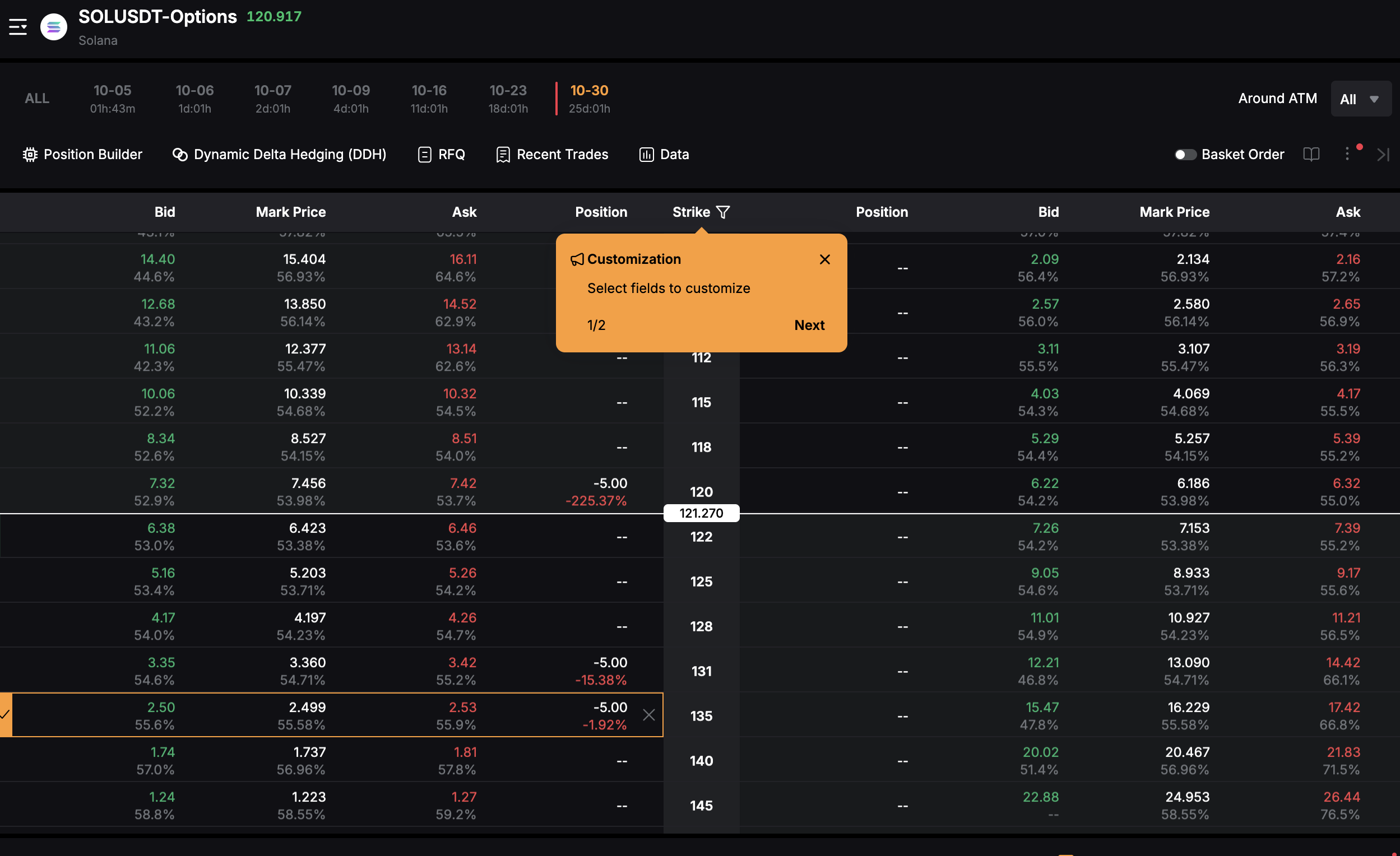
This is especially relevant for Solana because, unlike BTC and ETH, the available SOL options curve on Bybit is relatively short.
Our approach is therefore simple: never assume the next SOL expiry will be there. Check the chain, understand Bybit's listing cycle, and plan only around contracts that actually exist.
Why We Monitor SOL Expiries Closely
There is some history behind this caution.
The crypto bear market of 2022 dramatically changed liquidity across digital-asset markets. And in 2023, Bybit eventually reduced and then ceased its Solana options offering.
Bybit announced that from July 18, 2023, it would stop introducing new SOL options with weekly and monthly expirations. Daily expirations temporarily remained available. From August 3, 2023, Bybit stopped offering new Solana options altogether.
SOL options have since returned to Bybit and the market today is considerably broader.
But we remember that episode.
There is no reason to assume that the same thing is about to happen again, and we certainly do not expect it as our base case. Nevertheless, it is a useful reminder that exchange-listed crypto derivatives are products offered by an exchange — their availability is not permanent or guaranteed.
For a strategy that depends on repeatedly rolling exposure into new contracts, that matters.
It is one reason TerraMatris pays attention not only to SOL price, implied volatility and option premium, but also to the appearance of future expiry dates themselves.
What SOL Option Expiries Does Bybit Currently Offer?
According to Bybit's current options documentation, SOL options have seven expiry categories:
- Daily
- Bi-daily
- Tri-daily
- Weekly
- Bi-weekly
- Tri-weekly
- Monthly
Bybit currently applies the same seven-expiry structure to SOL, XRP, DOGE and MNT options.
BTC and ETH have a longer options curve.
For those assets, Bybit currently also offers bi-monthly and quarterly expirations, bringing the total to nine expiry categories.
That distinction is important.
Deribit does offer longer-dated SOL crypto options, including quarterly contracts,
Because our Solana Strategy trades SOL options on Bybit, the monthly SOL cycle is the one we monitor most closely.
When Does Bybit List New SOL Options?
Bybit's current rules make the process reasonably predictable.
Tri-daily options are introduced daily at 08:00 UTC, while the other new options contracts are introduced on Thursdays at 08:00 UTC.
For monthly expirations, the important rule is that a new monthly expiration is added as the existing calendar advances and the monthly contract moves into the shorter-dated part of the expiry structure.
In practice, this creates a rolling options ladder.
A SOL contract that initially represents the monthly expiry eventually becomes the tri-weekly expiry as time passes. At that point, the next monthly contract can enter the chain.
This is why simply looking at today's longest SOL expiration does not tell the whole story.
The important question is:
When does today's monthly contract move far enough down the expiry ladder for the next monthly contract to be introduced?
That is the date we watch.
A Practical Example: Waiting for the Next Monthly SOL Contract
Suppose the furthest SOL options expiry currently available is the final Friday of October.
A trader interested in selling options expiring near the end of November may initially open the Bybit options chain and find that the November monthly contract does not yet exist.
That does not necessarily mean Bybit will not offer it.
It may simply be too early in the listing cycle.
As the October monthly contract approaches expiry and becomes part of the tri-weekly window, the November monthly expiry should become eligible to appear under Bybit's normal listing schedule.
For TerraMatris, this distinction matters because there is a large difference between:
- entering a new monthly position immediately when the contract appears;
- waiting for the existing position to expire;
- entering with roughly four weeks remaining;
- or deciding that the available premium does not justify another cycle.
The calendar tells us when the opportunity becomes available.
It does not tell us whether we should trade it.
Expiry Is Only One Part of the Decision
The appearance of a new monthly contract is not itself a trading signal.
Before opening a SOL options position, we also look at factors such as:
- SOL spot price;
- strike distance;
- option delta;
- implied volatility;
- premium received;
- bid/ask spread;
- available liquidity;
- portfolio collateral;
- existing SOL exposure;
- assignment risk;
- and the amount of time remaining until expiration.
This is particularly important with SOL.
Compared with BTC or ETH options, SOL can have thinner liquidity at some strikes and expirations. A position that looks attractive from the quoted premium alone may be much less attractive once execution quality and the ability to adjust the position are considered.
We discussed this problem separately in our research on why rolling SOL options can be more difficult than BTC or ETH.
The expiry calendar therefore tells us what can be traded.
Risk, liquidity and pricing determine whether it should be traded.
Why TerraMatris Often Likes the Monthly Window
Our Solana strategy is not designed around maximizing the number of trades.
The broader objective is to maintain or accumulate SOL exposure while selectively using covered calls and cash-secured puts when the available terms make sense.
A roughly monthly options cycle can provide a useful middle ground.
Very short-duration options offer rapid time decay, but they also require frequent decisions and can leave little time to manage a rapidly moving underlying.
Longer-dated options provide more time and usually more absolute premium, but they also lock the strategy into a position for longer.
The monthly area gives us enough time for meaningful option premium while still allowing the strategy to reconsider its exposure relatively frequently.
There is no rule saying we must open every monthly cycle.
Sometimes the best decision is simply to wait.
The SOL Expiry Calendar Is Also a Liquidity Signal
There is another reason we watch the expiry ladder.
The continued availability and expansion of SOL expirations provides a small but useful indication of the development of the options market around Solana.
It should not be confused with a formal measure of liquidity. An expiration can exist while individual strikes remain difficult to trade.
But over longer periods, we are interested in whether the market is developing toward:
- more expirations;
- tighter spreads;
- deeper order books;
- better strike coverage;
- and eventually longer-dated SOL options.
BTC and ETH already have bi-monthly and quarterly expirations on Bybit. SOL does not currently have those longer options expiries.
If Bybit eventually extends the SOL curve further, it could create additional possibilities for position management and longer-duration option strategies.
Until then, we work with the market that actually exists.
Similar Expiry Logic Applies Across Bybit Crypto Options
Although this article focuses on Solana, the basic expiry-ladder concept is not unique to SOL.
Bybit uses related daily, weekly and monthly option cycles across several supported digital assets, including BTC and ETH, as well as SOL, XRP, DOGE and MNT. The exact number of available expiry categories varies by underlying.
BTC and ETH currently have the broadest expiry structure, extending through bi-monthly and quarterly contracts.
For TerraMatris, however, this page intentionally focuses on SOL options because Bybit is where we currently execute the options component of our Solana strategy.
What We Watch Before Each New SOL Cycle
Before starting another cycle, we want to answer a few basic questions.
Is the next monthly expiration already available?
How many days remain until expiry?
Has liquidity developed across the strikes we would realistically trade?
What premium is available relative to the downside or upside exposure being accepted?
And, most importantly, does opening another options position actually improve the portfolio?
That final question matters more than the calendar.
An option being available does not mean it needs to be sold.
Bottom Line
The Bybit SOL options expiry calendar is something we monitor continuously because contract availability directly affects how the TerraMatris Solana strategy can operate.
Today, Bybit offers SOL options ranging from daily through monthly expirations. New non-daily contracts are generally introduced on Thursdays at 08:00 UTC, while SOL's current expiry structure remains shorter than the BTC and ETH curves.
We remember the period when Bybit stopped introducing SOL options in 2023 and ultimately ceased the product altogether for a time. That history does not mean another delisting is imminent. It simply reinforces a principle we already apply throughout TerraMatris:
do not build a strategy around assumptions about future market infrastructure.
We monitor the contracts that exist, watch for the next expiry to appear, evaluate the available premium and liquidity, and make the next decision from there.
The calendar tells us when another cycle becomes possible.
The market tells us whether it is worth taking.
For the portfolio framework behind these trades, see our Solana Strategy.