Educational research only. Not investment, legal, tax, or trading advice. Options and digital assets involve substantial risk, including loss of capital. A premium received is not a guaranteed profit.
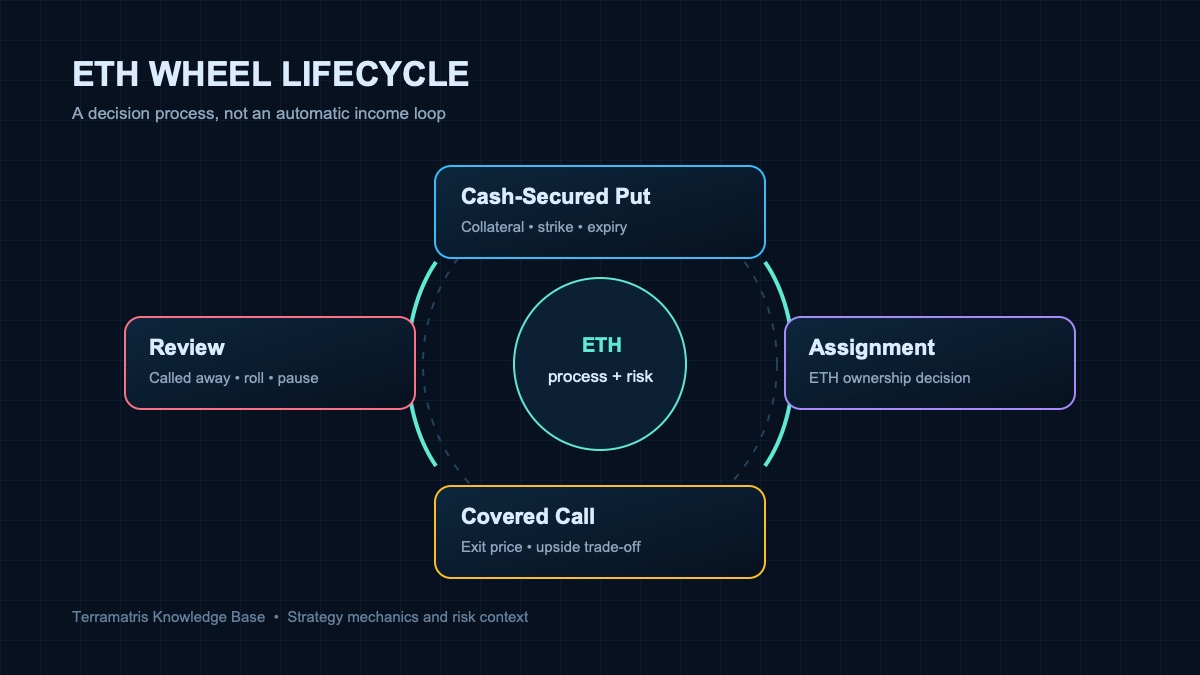
An Ethereum wheel strategy combines two familiar options positions: a cash-secured put and, after assignment, a covered call. In Terramatris's published Ethereum framework, cash-secured puts may lead to spot ETH accumulation; covered calls may then be written against that spot exposure. (Terramatris’s Ethereum Strategy)
The name can make the process sound automatic. It is not. Every expiry, assignment, roll, and new sale is a separate decision about exposure, capital, liquidity, and acceptable outcomes. The useful starting question is not how much premium a position may collect. It is whether you would be prepared to own ETH at the effective purchase price and hold that exposure if the market falls further.
The wheel in two stages
- Sell a cash-secured put on ETH.
- If the put is assigned or settles into spot exposure, hold ETH and consider selling a covered call against the amount held.
Terramatris describes its Ethereum Strategy as an internal closed-end strategy, established in August 2023, that uses cash-secured puts and covered calls and reinvests premiums into spot ETH. (Terramatris’s Ethereum Strategy) That description explains the framework; it does not establish that the framework will be profitable in a future market.
Stage one: cash-secured puts
A put seller receives a premium in return for taking on an obligation to buy ETH at a stated strike price if the contract is exercised or settles in the money. A cash-secured put means the trader has reserved sufficient collateral to meet that obligation without relying on fresh borrowing or the sale of unrelated assets.
Before opening a position, record:
- ETH spot price, strike, expiry, and contract size.
- Premium received and expected trading, settlement, and funding costs.
- Collateral required by the venue.
- Effective acquisition cost if assigned: strike less premium, adjusted for costs.
- Total ETH exposure if every open put is assigned.
- The intended response if ETH falls materially after assignment.
The premium can reduce the effective cost of an assigned position, but it does not remove downside. A low-delta strike may reduce the chance of assignment under a given model; it cannot eliminate assignment risk or protect against a sharp move.
If the put expires without assignment
If ETH is above the strike at expiry, the option may expire worthless and the seller retains the premium. That outcome should be described precisely as premium collected on an expired option. It does not by itself measure the result of a broader strategy, because capital was committed during the trade, costs may apply, and the next position introduces fresh risk.
For research or journal reporting, keep premium, realized closed-position P&L, costs, and open exposure separate. Terramatris's performance index is the appropriate internal destination for dated strategy reporting rather than an evergreen article such as this one. (Weekly Performance)
If the put is assigned
Assignment turns conditional exposure into spot ETH exposure. The decision then changes from whether to sell a put to how much ETH exposure is acceptable and how it should be managed.
Possible responses include:
- Hold the ETH without an options overlay.
- Sell a covered call at an exit price you would accept.
- Reduce exposure if assignment has exceeded a pre-set limit.
- Roll only after evaluating the replacement as a new position with new terms and risks.
Terramatris's published bot research discusses the importance of assignment logic and human review when a short-put system must distinguish an oversold move from a market that continues to weaken. (Terramatris’s assignment-logic note) This is a research design point, not a prediction of market direction or a recommendation to automate a trading decision.
Stage two: covered calls
A covered call combines spot ETH ownership with a call sold against that holding. The premium compensates the seller for giving up upside above the strike. If ETH rises above the strike, the ETH may be called away or the position may settle according to the venue's contract rules. If ETH declines, the call premium offers only a limited offset against the decline in spot value.
The trade-off is direct:
- If the call expires worthless, the seller keeps the premium.
- If ETH rises beyond the strike, upside above the strike is capped or the ETH may be sold at that level.
- If ETH falls, the holder still bears meaningful spot-market downside.
Strike selection is an exposure decision, not a universal yield target. It depends on cost basis, desired exit price, expiry, implied volatility, liquidity, tax and accounting treatment, and the maximum ETH exposure the trader is willing to carry. Any example of a strike or premium is hypothetical unless it is identified as a dated, sourced historical record.
A decision checklist before each cycle
Use a written checklist before selling a new option:
- Is the required collateral available without leverage?
- Would assignment take total ETH exposure beyond the approved limit?
- Is the strike an acquisition or exit price that remains acceptable without counting the premium?
- Is market depth adequate and is the bid/ask spread acceptable for the intended size?
- Are settlement mechanics, fees, funding, and venue-specific risks understood?
- What event would trigger a pause, reduction, or manual review?
- Are premium, realized P&L, costs, and unrealized exposure reported separately?
A checklist does not make a position safe. It makes the trade assumptions visible before the outcome is known.
Risks the wheel cannot remove
A wheel strategy cannot guarantee income, prevent drawdowns, eliminate assignment risk, make leverage safe, or ensure that rolling a position improves its economics. Results depend on the path of ETH, option pricing, execution quality, liquidity, costs, contract terms, position size, and risk limits.
Digital-asset options add operational risks. Contract specifications, collateral rules, settlement method, venue availability, and liquidity may differ by platform. A trader should understand those terms before opening a position. If the strategy uses a bot or rule-based workflow, automation does not eliminate the need for monitoring, risk limits, and escalation rules.
Terramatris publishes research and educational material. It does not accept deposits, manage third-party capital, or trade on behalf of investors. (About Terramatris) Nothing in this article creates an offer, a performance promise, or a claim on any Terramatris strategy or asset.
Related Terramatris research
The following internal links can help readers move from the framework to the underlying research and dated reporting:
- Ethereum Strategy: Terramatris's published ETH options framework.
- Options Premium Is Not Profit: how to separate premium, realized P&L, unrealized P&L, and portfolio value when reading a wheel cycle.
- 1-DTE ETH Options Bot: Rules, Guardrails and Risks: the automation boundaries and human-review rules relevant to short-dated put workflows.
- Backtesting Ethereum: How Often Does ETH Drop?: first-party drawdown research relevant to assignment scenarios.
- Weekly performance: dated strategy records and reporting fields.
- About Terramatris: company positioning and disclosures.
Reference on options risks
The Options Clearing Corporation’s Characteristics and Risks of Standardized Options is a general educational reference for listed options. Crypto-options venues can use different contract, collateral, settlement, and liquidity arrangements; readers should review the applicable venue documentation before relying on any mechanics described here.