Educational research only. Not investment advice, a recommendation to trade options, or a performance claim. Options and digital assets involve substantial risk, including the potential for losses and assignment-related exposure.
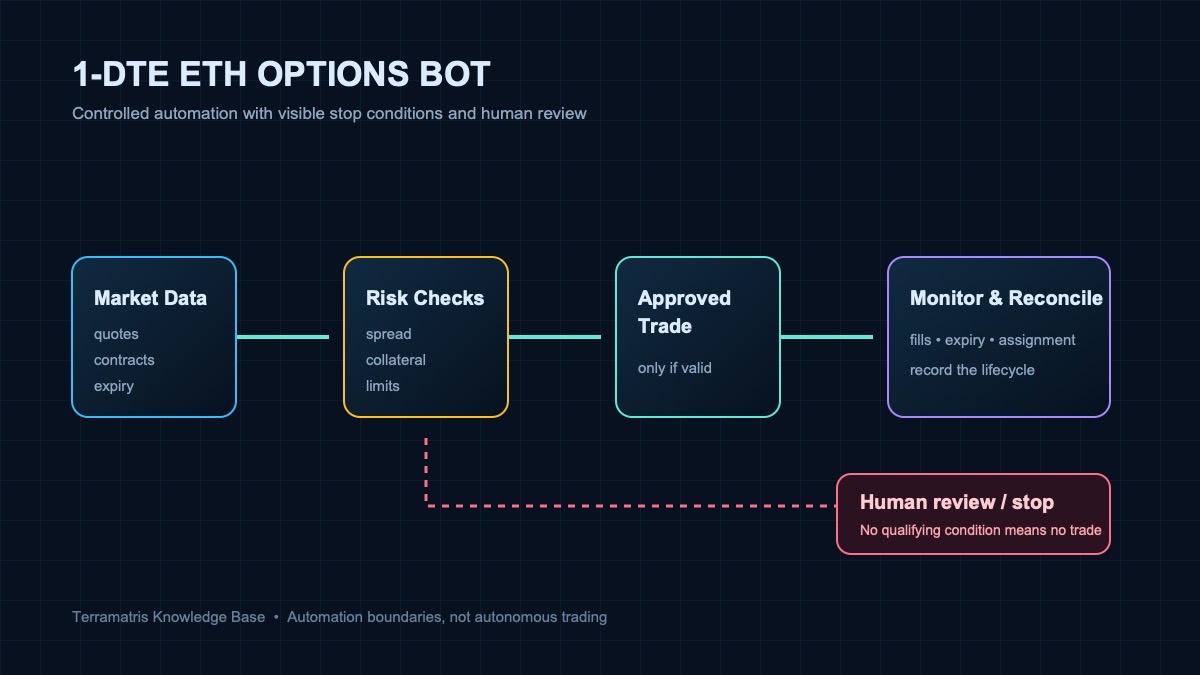
A one-day-to-expiry (1-DTE) ETH options bot can automate a narrow, repetitive workflow: obtain permitted market data, exclude contracts that fail predefined checks, place or manage an order within approved limits, and record what occurred. Automation does not make the strategy autonomous, risk-free, or suitable for every market condition.
Terramatris documents an internal Ethereum strategy based on cash-secured puts and covered calls, with premiums reinvested into spot ETH. Its published framework also describes using a 1-DTE ETH-options bot subject to predefined rules. (Ethereum Strategy) This article explains a research-oriented control framework for such a system. It does not report bot returns, predict outcomes, or recommend selling options.
What a 1-DTE bot should—and should not—do
A narrowly scoped bot may help make a documented process more consistent. In a hypothetical workflow, it can check quote freshness, liquidity, contract metadata, collateral, position limits, and pre-approved entry criteria before it is permitted to act.
It should not improvise around a failed condition. If a quote is stale, a spread is outside the rule, collateral is unavailable, a contract does not fit the risk parameters, or an event requires review, the appropriate result is no trade or a pause.
Terramatris’s published bot research describes short-duration put strategies and manual intervention for challenged positions. It also describes a decision not to automate every assignment or roll decision. (Terramatris’s assignment-logic note) That distinction matters: an automated order workflow is not a substitute for defined lifecycle and risk-management procedures.
Define the rules before enabling automation
A credible system starts with a written, versioned rule set. The following are educational examples of categories that may need to be specified; they are not trading instructions.
Market-data and venue rules
- Identify the permitted venue, contract types, data feeds, and contract metadata.
- Set a maximum quote age and define how the system identifies stale or inconsistent data.
- Define acceptable bid/ask spread and minimum order-book depth.
- Specify the response to an exchange API error, feed failure, clock mismatch, missing contract data, or rejected order.
Trade-selection rules
- Define the permitted underlying and expiry window, including the exact time convention for “1-DTE.”
- Use a maximum absolute delta only as a selection constraint—not as certainty about assignment or price direction.
- Define strike-distance, premium, maximum contract-size, collateral, and aggregate-exposure limits.
- Require the candidate to satisfy every applicable condition. A premium alone is not a sufficient reason to trade.
Lifecycle and approval rules
- Define when the system may open, monitor, close, or allow a position to reach expiry.
- Document how assignment, exercise, settlement, fees, and reconciliation are detected and recorded.
- Define conditions that pause the bot and conditions that require explicit human approval.
- Record each human override, its reason, and whether it resulted in a rule-set change.
Guardrails that preserve the research process
No qualifying contract means no trade
The system should not relax its delta, liquidity, or spread requirements simply to generate activity. Terramatris’s later bot description includes a comparable principle: require valid bid/ask information, acceptable spreads, and sufficient data, without automatically falling back to a riskier strike. (Terramatris’s assignment-logic note)
Treat assignment as a planned state transition
A short put may finish in the money. Assignment should therefore have a documented response that addresses collateral, resulting spot exposure, subsequent covered-call rules where applicable, settlement mechanics, and any required human review. A workflow that ends at order entry is incomplete.
Separate selection quality from execution quality
A candidate that meets a statistical or pricing rule can still be unsuitable to execute if the quote is stale, the spread is wide, a fill is unreasonable, or collateral data are wrong. The research record should distinguish the intended trade from the accepted order, fill price, slippage, fees, and final lifecycle outcome.
Use hard stops as operational controls
Examples of hypothetical hard-stop conditions include a missing price feed, API failure, abnormal spread, data disagreement, a daily loss limit, or an aggregate-assignment limit. Such controls do not predict the market; they define when the system is no longer authorized to operate within known conditions.
Make human intervention auditable
Human review can be appropriate, particularly for assignment, settlement, or incomplete rules. Each intervention should state who acted, why they acted, which rule was insufficient, and whether the written process changed. Without that record, the results are neither fully systematic nor transparently discretionary.
Failure modes to test for
A 1-DTE workflow concentrates operational decisions into a short time window. Educational research should account for, at minimum:
- overfitting a small sample or a calm-volatility period;
- treating delta as an exact probability of assignment;
- correlated assignment risk across multiple short puts;
- thin markets where a headline premium does not translate into executable pricing;
- margin, funding, fees, settlement timing, and reconciliation errors;
- automation that covers entry but not assignment, roll, expiry, or reporting; and
- continuing operation while a material risk rule is missing.
Terramatris has publicly discussed pausing a bot when market conditions and incomplete assignment-management rules made continued operation uncomfortable. (Terramatris’s assignment-logic note) This is an example of the intended function of a guardrail: the system is not required to create activity when its documented conditions are not met.
A practical research test plan
Rather than begin with a claim that the bot “wins,” test whether it follows its rules across different conditions:
- Simulate stale quotes, empty order books, API failures, rejected orders, and data mismatches.
- Test expiry, assignment, settlement, and reconciliation handling against known historical cases.
- Start with deliberately limited exposure while logging every candidate, rejection, order, fill, override, and lifecycle event.
- Keep realized profit and loss distinct from premium received, unrealized exposure, fees, and capital at risk.
- Set a minimum sample and market-regime coverage standard before revising exposure limits.
- Publish only decisions and data that can be supported, dated, and described with their limitations.
The useful output of a bot experiment is a better documented answer to three questions: when may the system act, when must it stop, and how does a human remain accountable?
Risk and disclosure
This material is educational and informational. It is not an offer, solicitation, recommendation, or investment advice. It does not describe a managed account or third-party capital program. Terramatris states that it does not accept deposits, manage third-party capital, or trade on behalf of investors. (About Terramatris)
Short-duration options can involve rapid changes in exposure. Cash-secured puts may result in assignment; covered calls may limit upside on the underlying; liquidity, spreads, execution, venue operations, settlement, and data quality can materially affect outcomes. Historical observations, if published elsewhere, are not forecasts and should not be interpreted as a promise of return.
Related Terramatris research
Suggested internal links for publication:
- Ethereum Strategy — `/ethereum-strategy`: Terramatris’s published internal ETH framework, including cash-secured puts, covered calls, and the rule-based 1-DTE bot reference. (Ethereum Strategy)
- Ethereum Wheel Strategy — `/ethereum-wheel-strategy-guide`: the decision sequence from cash-secured puts through assignment, spot exposure, covered calls, and rolling.
- Options Premium Is Not Profit — `/options-premium-is-not-profit`: the reporting framework that keeps premium, realized P&L, unrealized P&L, and portfolio value distinct.
- Weekly Performance — `/performance`: the canonical index of dated Terramatris reporting; use an individual dated report when citing a historical value or event. (Weekly Performance)
- Strategies — `/strategies`: overview of Terramatris crypto-options strategy research.
- About Terramatris — `/about`: company positioning and disclosures. (About Terramatris)